
Resolve AI vs. Opsphere: SRE Fit Beyond the $1B Headline
Resolve AI vs. Opsphere: SRE Fit Beyond the $1B Headline

Resolve AI is an agentic AI SRE platform built to autonomously triage, investigate, and support remediation of production incidents, with investor coverage citing faster mean time to resolution and quicker triage for enterprise pilots. For engineering leaders evaluating agentic tools for production operations, the practical question is less “does this work” and more “which approach fits our telemetry, governance needs, and team structure.” We break down how Resolve AI positions itself, what independent reporting says, and where an operational intelligence platform like Opsphere fits the same buyer job with a different architecture.
TL;DR:
- Salesforce Ventures reports pilot results of roughly 60% lower MTTR, 70% faster triage, and 30% less investigation time; these figures are not independently audited.
- Set a 4 to 8 week pilot, track MTTR, triage latency, false action rates, and audit log completeness, and define rollback thresholds before launch.
- Opsphere connects existing AWS, Kubernetes, observability, CI/CD, and security tools through more than 300 read only operational tools, grounding investigations in source systems.
- Start with cloud, Kubernetes, and observability connections, then test investigations against resolved incidents before granting write access or defining autonomous remediation boundaries.
Table of Contents
- Resolve AI: company snapshot and positioning
- How Resolve AI’s platform works: capabilities, integrations, and controls
- Industry context, evidence, and an evaluation checklist for engineering leaders
- Use cases and real-world examples in production incident response
- Comparison with competing AI-powered operational intelligence tools
- Customization options and scalability across team sizes
- Training and support resources for teams adopting Opsphere
- Best practices for integrating Opsphere with DevOps, SRE, and platform workflows
- Opsphere: an operational-intelligence approach you can evaluate next
- FAQ
- Sources
Resolve AI: company snapshot and positioning
Resolve AI is led by co-founders Spiros Xanthos and Mayank Agarwal, who previously co-created OpenTelemetry and held senior roles at Splunk, according to investor reporting from Salesforce Ventures. That pedigree matters to buyers: OpenTelemetry’s origins sit at the center of modern observability instrumentation, and prior Splunk leadership signals familiarity with enterprise monitoring at scale.
The company’s market position shifted quickly. TechCrunch reported that Resolve AI reached a headline $1 billion valuation structure following a Series A led by Lightspeed, with coverage emphasizing the founding team’s background and rapid growth trajectory. Fast funding cycles at this stage usually reflect strong investor conviction in agentic production tooling as a category, not confirmation of specific operational outcomes at any given customer.
Independent write-ups from investors describe the company’s positioning clearly:
- Resolve AI frames itself as agentic AI for production, aiming to automate core SRE workflows rather than just surface alerts.
- Investor coverage cites customer pilot outcomes, including reported reductions in MTTR and faster triage times, as evidence of real-world traction.
- The founding team’s OpenTelemetry and Splunk backgrounds are presented as a credibility signal for enterprise buyers evaluating a young company.
For procurement teams, this snapshot is useful context. It does not replace a technical evaluation against your own telemetry stack, which is where the next section matters more.
How Resolve AI’s platform works: capabilities, integrations, and controls
Strip away the marketing language and an agentic SRE platform like Resolve AI typically operates through a few connected stages. Understanding this sequence helps engineers evaluate whether the architecture fits their incident response reality.
- Signal ingestion: the platform pulls in logs, traces, metrics, and topology data from existing observability and infrastructure tools rather than replacing them.
- Autonomous triage: incoming alerts get correlated and prioritized, reducing the manual sorting that consumes early incident minutes.
- Hypothesis-driven investigation: the system generates and tests root-cause hypotheses against available evidence, narrowing down likely causes before an engineer gets paged in detail.
- Remediation suggestion: based on investigation findings, the platform proposes a remediation plan, which may range from a runbook step to a scoped automated action.
- Human checkpoint: critical actions typically route through a human-in-the-loop gate before execution, particularly for anything beyond read-only diagnostics.
The integration surface an agentic platform needs is substantial: CI/CD pipelines, Kubernetes clusters, cloud provider APIs, observability backends, and incident management tools all need to feed context in. Coverage gaps in any of these reduce the quality of autonomous triage, since the system can only reason over what it can see.
Governance concepts worth scrutinizing before any pilot include whether actions are read-only by default, whether remediation steps are scoped to specific blast radius limits, and whether every agentic action generates an auditable log entry. Independent analysis of AI in high-stakes domains, including the Belfer Center’s research on AI decision-making, recommends treating autonomous systems with structured due diligence and sustained human oversight rather than full delegation, a principle that applies directly to production incident automation.
Pro Tip: Ask any agentic SRE vendor for a sample audit log from a real remediation action before signing, not just a demo environment walkthrough.
Industry context, evidence, and an evaluation checklist for engineering leaders
The investor narrative around Resolve AI is specific. Salesforce Ventures reported customer deployments showing roughly a 60% reduction in MTTR, about 70% faster alert triage, and close to a 30% reduction in investigation time, figures that come from an investor write-up rather than an independent audit.
Resolve AI’s investor-cited pilot results: a reported 60% MTTR reduction and 70% faster triage, according to Salesforce Ventures, illustrate the scale of improvement agentic platforms claim in enterprise deployments, though prospective buyers should validate comparable metrics in their own environment before committing budget.

The same investor commentary pairs its optimism with a caution: autonomous SRE agents need steerable guardrails and ongoing human oversight to avoid over-reliance. That caution echoes broader research on AI in other high-stakes domains, where the Belfer Center recommends conservative rollouts and explicit oversight structures rather than open-ended autonomy.
Before running any pilot of an agentic SRE tool, a practical checklist helps separate marketing claims from operational fit:
- Define pilot success metrics up front: MTTR, triage latency, false-action rate, and completeness of audit logs.
- Confirm telemetry coverage across your actual stack, not a subset chosen to flatter the demo.
- Require governance checks: read-only defaults, scoped action boundaries, and reviewable logs for every automated step.
- Set a defined pilot window, commonly 4 to 8 weeks, with a rollback plan if false-action rates exceed your risk tolerance.
Data collected during that window, not the vendor’s investor deck, should drive the go or no-go decision.
Use cases and real-world examples in production incident response
Agentic SRE tools get evaluated against a handful of recurring scenarios, and the pattern is consistent across vendors: the value shows up most clearly when an incident spans multiple systems and the manual correlation work would otherwise consume the first 20 to 30 minutes of response.
A typical use case looks like this: a latency spike in a checkout service triggers alerts from three separate monitoring tools simultaneously. Instead of an on-call engineer manually cross-referencing logs, traces, and recent deployments, an agentic layer correlates the signals, surfaces a recent configuration change as the likely cause, and presents that hypothesis with supporting evidence before a human even opens a terminal. Another common pattern involves recurring, well-understood incident types, like a specific database connection pool exhaustion, where automated runbook generation turns institutional knowledge into a repeatable response rather than relying on whichever engineer remembers the fix from last time.
The operational efficiency gain in both cases comes from compressing the investigation phase, not from replacing the engineer’s judgment on whether to act. Teams adopting any agentic platform, Resolve AI included, tend to see the clearest early wins on alert correlation and noise reduction before trusting the system with broader autonomous decision-making. That staged trust curve is itself a useful signal: a platform that produces evidence-backed findings an engineer can verify quickly earns expanded scope faster than one that asks for blind trust from day one.
Comparison with competing AI-powered operational intelligence tools
Agentic SRE platforms generally split along a few architectural lines worth understanding before you shortlist vendors. Some tools are built primarily as autonomous agents that act on your behalf with minimal required setup, prioritizing speed of autonomy over breadth of context. Others are built as an operational intelligence layer that unifies context across your existing tools first, then layers agentic capabilities on top, prioritizing evidence and auditability over immediate autonomy.
Resolve AI falls into the first category: an agent-first platform aiming to automate triage and remediation workflows end to end, which investor coverage frames as a differentiator for teams wanting maximum automation, quickly.
We take the second approach. Opsphere connects to your existing AWS, Kubernetes, observability, CI/CD, and security tools without requiring you to replace any of them, and builds unified operational context from that connected surface before any agent acts. Our AI Agents operate through a Model Context Protocol across more than 300 read-only operational tools, which means investigation findings are tied directly back to the source-of-truth system that generated them, not abstracted into a separate data layer that could drift from reality. For engineering leaders comparing options, the practical distinction is whether you want a platform that acts fast and asks for trust, or one that shows its evidence first and expands scope as that evidence proves reliable.

Customization options and scalability across team sizes
An operational intelligence platform needs to flex from a five-person platform team to a multi-thousand-engineer organization without forcing either end to overpay for capability it does not use. The platform offers plans that fit individual engineers and small teams getting started, plans serving growing engineering organizations that need shared context and collaborative investigation workflows, and plans adding the governance, access control, and scale needed for larger, regulated environments.
Scalability for an agentic operational platform is not just about seat count. It is about whether the unified context model holds up as the number of connected tools, services, and environments grows. Because the architecture pulls context through a read-only MCP gateway rather than duplicating telemetry into a parallel store, adding new integrations or scaling to additional clusters does not require re-architecting how investigations work. A free tier is available, giving smaller teams or individual contributors a path to evaluate the core investigation workflow before committing budget. Custom solutions are available for organizations with specific compliance, deployment, or integration requirements that fall outside the standard plans, with pricing available on request.
That range matters for a technology and engineering audience specifically: a platform that only works well at enterprise scale forces smaller teams into tools they will outgrow, while a platform built only for small teams rarely survives procurement review at larger organizations.
Training and support resources for teams adopting Opsphere
Rolling out an operational intelligence platform touches on-call workflows, existing tool configurations, and incident response habits that took years to build, so support resources matter as much as the product itself. We provide documentation and platform guidance through our product pages covering setup, integration patterns, and investigation workflows, giving engineering teams a reference point as they connect their stack.
For teams evaluating safe automation practices specifically, our blog post on moving from read-only agents to scoped remediation walks through the governance considerations that typically come up during a pilot, including how to define action boundaries before granting any agent write access. Partner guidance from outside our own documentation also helps here: Wattle AI’s overview of guardrails, telemetry, and red teaming for AI agents offers practical detail on hardening agentic systems before production rollout, a useful complement to platform-specific setup guides.
Enterprise customers evaluating Custom Solutions get direct support in scoping integration requirements and governance needs specific to their environment, since no two organizations connect the same combination of cloud providers, observability stacks, and security tooling. The goal across every tier is the same: a team should be able to connect their existing tools, run their first evidence-backed investigation, and understand the governance model before any agent gains scoped remediation access.
Best practices for integrating Opsphere with DevOps, SRE, and platform workflows
Successful rollouts of an operational intelligence layer tend to follow a similar sequence regardless of team size. Start by connecting the tools your team already relies on daily, typically your cloud provider, Kubernetes clusters, and primary observability backend, rather than trying to integrate your entire toolchain on day one.
Once core telemetry is connected, run a handful of real investigations through the platform on incidents you have already resolved manually. This lets your team compare the evidence-backed findings against what you already know happened, building calibrated trust in the investigation quality before any automation gets write access to production. From there, define scoped remediation boundaries explicitly: which actions can run autonomously, which require a human approval step, and which stay strictly informational.
Teams running GitOps workflows with tools like Argo CD or managing infrastructure through Terraform should map which of those control planes the platform can observe versus act on, since read-only visibility into a deployment pipeline is a different integration than scoped write access to trigger a rollback. Opsphere’s investigations documentation details how evidence-backed findings tie back to source systems, which helps engineering leads set these boundaries with specifics rather than guesswork. For validating incident signals before escalation, pairing operational intelligence with multi-location uptime confirmation, as Uptime Beacon recommends for on-call teams, reduces false-positive pages that erode trust in any automated system.
Opsphere: an operational-intelligence approach you can evaluate next
We built Opsphere around a specific belief: unified operational context should come from your existing tools, not a replacement for them. Our AI Agents work through a Model Context Protocol across more than 300 read-only operational tools, pulling evidence from AWS, Kubernetes, observability platforms, CI/CD pipelines, and security systems into a single investigation surface without duplicating telemetry or breaking source-of-truth ownership.
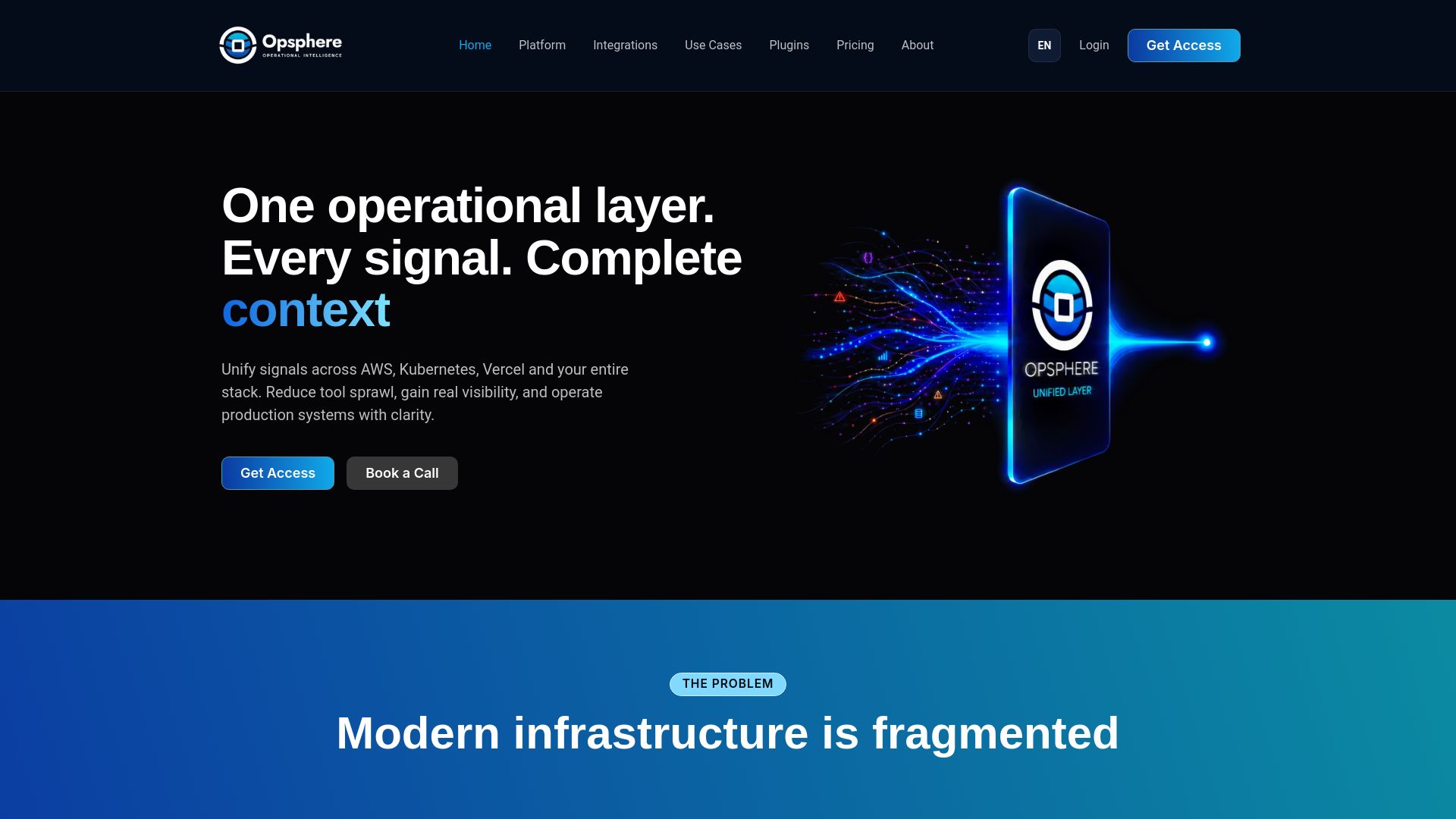
That design carries directly into how we handle safe automation. Investigations are evidence-backed by default, remediation actions stay scoped to boundaries your team defines, and every connected tool keeps its read-only status unless you explicitly grant broader access. For engineering leaders who want autonomy without losing visibility into what an agent actually did and why, that governance-first sequence matters as much as the automation itself.
A practical pilot with us typically looks like this:
- Connect your core telemetry sources: cloud provider, Kubernetes, and primary observability backend.
- Run several investigations against incidents you have already resolved, comparing our evidence-backed findings to your own post-incident reviews.
- Track MTTR and triage latency changes over a defined pilot window, alongside governance signals like audit log completeness.
- Review scoped remediation boundaries with your team before granting any write access.
If you are ready to see how this fits your stack, explore our platform overview or check pricing across our Developer, Team, Enterprise, Community, and Custom Solutions plans to find the right starting point for your team.
FAQ
What exactly does Resolve AI do?
Resolve AI is an agentic AI SRE platform that autonomously triages incoming alerts, investigates production incidents by testing root-cause hypotheses against telemetry evidence, and proposes or supports remediation steps. Investor coverage from Salesforce Ventures describes enterprise pilots using the platform to reduce manual triage and investigation time.
Who leads Resolve AI, and what is their background?
Resolve AI is co-founded by Spiros Xanthos and Mayank Agarwal, who previously co-created OpenTelemetry and held senior engineering roles at Splunk, according to Salesforce Ventures. That background is frequently cited in investor and press coverage as a credibility signal for the company’s technical direction.
Is Resolve AI a publicly traded company?
No, Resolve AI is a privately held startup, not a public company, so there is no publicly traded stock associated with it. TechCrunch reported that the company reached a headline $1 billion valuation structure through a Series A funding round rather than a public offering.
What should we measure before trusting an agentic SRE platform with production actions?
A sound pilot tracks MTTR, triage latency, false-action rate, and audit log completeness over a defined window, typically several weeks, before expanding any platform’s scope. Independent research on AI in high-stakes domains, including the Belfer Center’s analysis, recommends sustained human oversight rather than full delegation during this evaluation phase.
How does Opsphere differ from an agent-first autonomous platform?
We build unified operational context first by connecting to your existing tools through a read-only Model Context Protocol across more than 300 operational integrations, then layer AI Agents on top for evidence-backed investigation and scoped remediation. This sequence prioritizes auditable evidence and governance before expanding automation scope, which fits teams that want to validate agentic findings against known systems before granting broader action rights.
Sources
- Autonomous Production With AI | Salesforce Ventures
- Ex-Splunk execs’ startup Resolve AI hits $1B valuation with Series A | TechCrunch
- AI and the future of conflict resolution: how can artificial intelligence improve peace negotiations? | Belfer Center
Recommended
This article is provided for general informational purposes only and does not constitute professional, legal, security, or compliance advice. Please evaluate recommendations against your organization’s specific environment and requirements.