

Operational intelligence for infrastructure
Unify signals across AWS, Kubernetes, Vercel and your entire stack. Reduce tool sprawl, gain real visibility, and operate production systems with clarity.
THE PROBLEM
Modern infrastructure is fragmented
Every tool shows part of the story. Understanding the full picture still requires jumping between dashboards, logs, alerts and deployment systems.
Too Many Tools
Logs, metrics, alerts, deployments, pipelines — each lives in a different system. You spend more time switching tools than understanding what's happening.
No Cross-System Context
Signals are scattered across platforms. There is no single place to understand the real state of your system.
Operational Noise
Alerts and dashboards are disconnected. Important signals get lost in a sea of irrelevant complexity.
Growing Complexity
As you scale and evolve, so does the operational burden. More services, more integrations, more failure points.




WHAT IS OPSPHERE
A single operational intelligence layer across your entire stack
Opsphere connects your existing infrastructure, observability, deployment, code and edge systems. It queries their data and brings relevant evidence together for investigations and decisions.
- Query data where it lives
- Connect evidence across systems
- Retain context for the next investigation
Your tools remain the source of truth. Opsphere connects the operational knowledge between them.
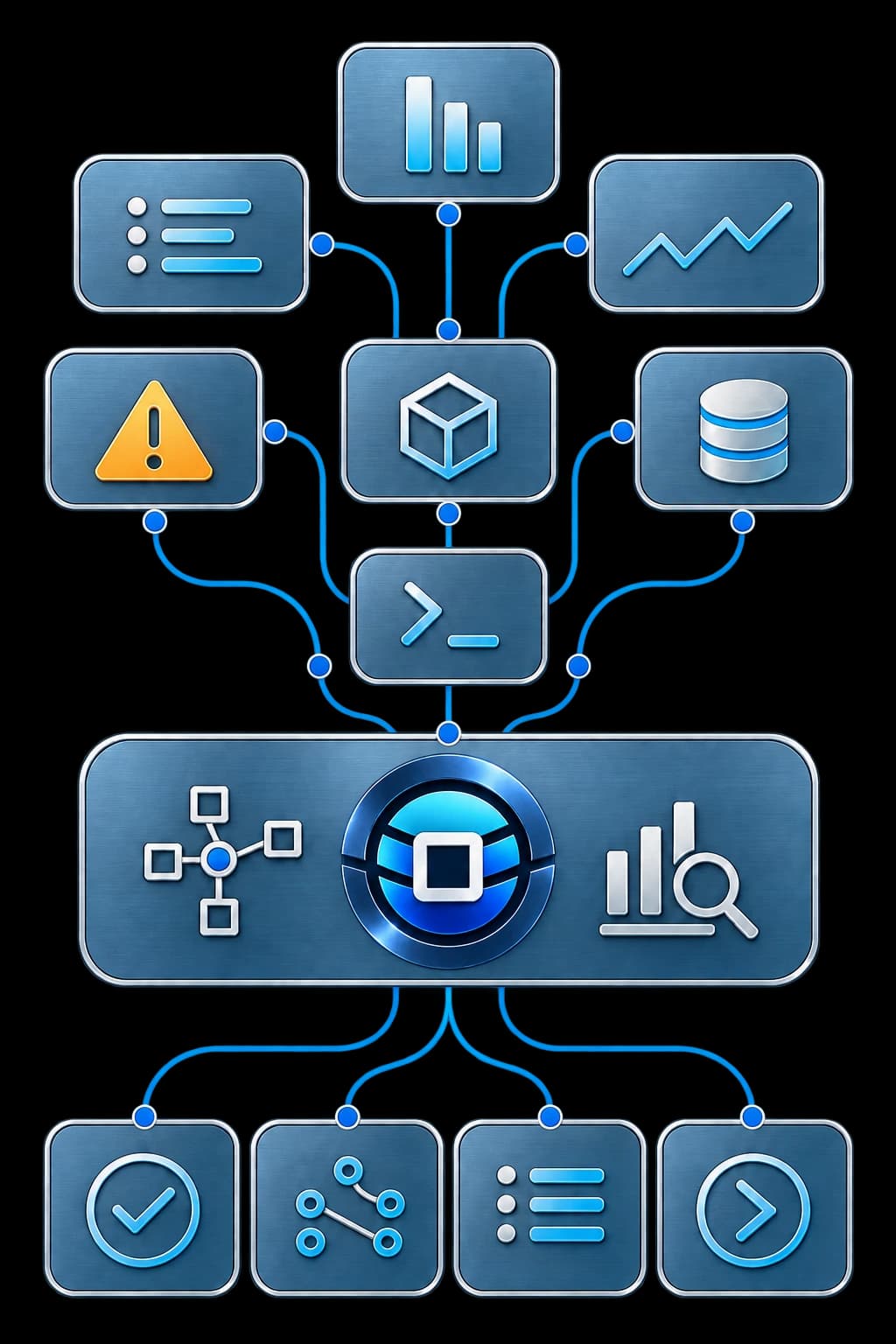
HOW IT WORKS
From fragmented systems to operational understanding
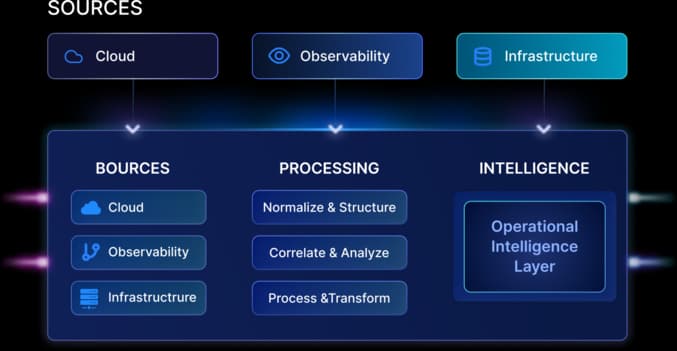
Opsphere retrieves evidence from your existing systems and connects it to the operational question. It retains useful context for future investigations. Your tools keep their data. Opsphere adds a structured operational layer across them.
Connect to your existing stack
Connect cloud, Kubernetes, observability, deployment, code, security and edge without replacing your tools.
Query and correlate operational evidence
Query current signals in their source systems and connect infrastructure, changes and errors when needed.
Investigate with structured evidence
Test hypotheses against real results, calculated confidence, timelines and verification conditions.
Retain operational context
Reuse relationships and findings from earlier investigations without copying telemetry.
OPERATIONAL SUBAGENTS
Specialized agents for the moments that demand a repeatable response
Opsphere includes read-only subagents that follow focused operational runbooks, collect current evidence and return a structured report.
/outage-triageOutage triage
Coordinates the first diagnostic pass, connects signals and identifies the strongest next checks.
/endpoint-healthEndpoint health
Checks DNS, HTTP and TLS evidence to explain whether an endpoint is reachable and healthy.
/ci-investigatorCI investigation
Reviews pipeline failures, failed jobs and relevant logs to isolate the likely cause.
/postmortem-writerPost-mortem drafting
Turns the evidence, timeline and decisions from an incident into a reusable structured draft.
Each subagent reports evidence, gaps and next steps while the source systems remain authoritative.
Comparisons with other products
Opsphere compared with querying each system separately
When each console holds only part of the evidence, an incident investigation has to rebuild context again and again.
Opsphere connects those signals without replacing the source systems. They retain authority over their data; access is read-only by default.
EVIDENCE-BACKED INVESTIGATIONS
Investigate with evidence, not assumptions
Opsphere tests possible causes against evidence from your existing systems. It separates facts from inference and checks supporting and contradicting evidence. Calculated confidence shows how strongly the evidence supports each conclusion. Explicit verification conditions make clear what still needs checking.
Parallel hypotheses
Evaluate several plausible explanations at the same time instead of committing too early to a single cause.
Evidence-backed conclusions
Link findings to real results from infrastructure, observability, deployment, code, network and other operational tools.
Calculated confidence
Confidence is derived from evidence quality, independent sources and contradictions — not simply from how confident an AI model sounds.
Verification conditions
Define what must become true before treating a conclusion or recommended resolution as validated.




Facts, inference and confidence remain distinct — so teams can see why Opsphere reached a conclusion.
OPERATIONAL CONTEXT
Your next investigation doesn't start from zero
Opsphere connects services, environments, repositories, accounts and domains through Operational Context. It reuses relevant knowledge from earlier investigations. Retrieval is scoped to the tenant, account and environment under investigation. Metrics, logs, traces, code and infrastructure stay in their source systems.
Operational Knowledge Graph
Maintain structured relationships between relevant operational entities so Opsphere can understand how parts of the environment connect.
Investigation Memory
Preserve structured findings, hypotheses, conclusions, evidence references, recommendations and verification from previous investigations.
Similar incident context
Surface relevant previous investigations when symptoms, services, environments or other operational signals overlap.
Scoped operational context
Retrieve only the context relevant to the current tenant, account and environment instead of loading unrelated knowledge into every investigation.


Your tools remain the source of truth. Opsphere keeps the operational knowledge between them.
INTEGRATIONS
Built for the stack you already use
Cloud. CI/CD. Observability. Security. Deployment platforms. Everything connects into a single operational layer.
Each connection stays in the system that already owns the data. Opsphere reads that operational evidence when an investigation needs it, so cloud, deployment, code, and edge signals can be correlated from one operational intelligence layer instead of a disconnected set of consoles.


















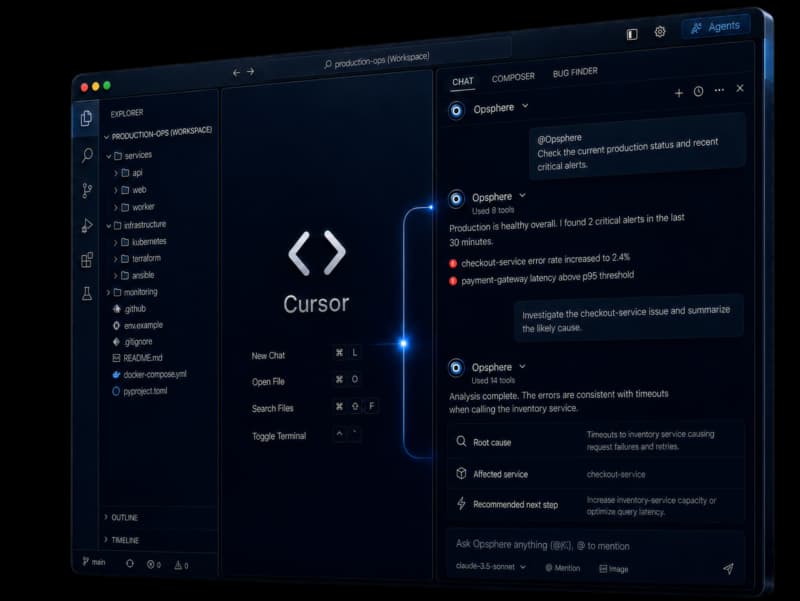
CURSOR INTEGRATION
Turn Cursor into your operational command center
Query your infrastructure and inspect systems directly from Cursor. Opsphere brings operational evidence into your development workflow across local, remote and server environments. Access is read-only by default.
AI COMPATIBILITY
AI where it adds value - not where it adds noise
Opsphere supports integration with AI engines without forcing a specific model or vendor. Bring your own OpenAI or Mistral keys, or use managed options when needed. AI is applied as a processing layer to enhance decision-making — not as a replacement for your infrastructure.
Bring Your Own AI Keys
Integrate OpenAI, Mistral, or other providers using your own API keys. Full control and data sovereignty — no vendor lock-in.
Optional Managed AI
Need a simpler setup? Use Opsphere's managed AI layer for teams that prefer not to manage their own model integrations.
Token-Based Usage Model
Fair and transparent consumption metrics. Pay for what you use with no hidden costs or usage limits per organization.



WHO IT'S FOR
Designed for modern infrastructure teams
Built for teams operating production systems, not managing dashboards.
Small SRE teams, AWS and Vercel startups, e-commerce teams and Terraform users already run production infrastructure. Opsphere connects their evidence in one Operational Intelligence Layer. Each investigation can reuse that context instead of rebuilding it across consoles.
Small SRE Teams
Operate complex systems with limited resources, without adding more tools.
AWS + Vercel Startups
Unify cloud and frontend operations into a single view.
E-Commerce Microservices
Understand system behavior across distributed services and integrations.
Terraform-Native Teams
Align infrastructure as code with real-time operational visibility.




KEY BENEFITS
Clarity over complexity
One platform to replace the context-switching, the dashboard proliferation, and the operational guesswork.
Teams see shared evidence across infrastructure tools. They spend less time switching consoles and make decisions from the same operational context.
WEB CLIENT
Access your operational layer from anywhere
Use the Web Client to query systems and review findings in your browser, without local setup. This optional add-on offers controlled AI usage and flexible token allocation per user.
Browser-native access
No local setup required. Works from any device.
Isolated per user
Strict session isolation — credentials never shared.
Optional add-on
Token-based AI usage with flexible allocation per user.


DIRECT ANSWERS
Key facts about Opsphere
A concise, verifiable summary based on the capabilities and operating boundaries described on this page.
What is Opsphere?
Category: Operational Intelligence Layer. Opsphere connects your existing tools into a shared operational view.
Source: Product facts
How does Opsphere work?
Connect the systems you already run, query their current evidence, correlate what the question needs, investigate with that evidence, and retain the context for the next question.
Source: Product facts
Does Opsphere change production systems?
Access mode: Read-only by default. Opsphere inspects systems and recommends next steps.
Production context is split across the tools that already run the stack. Opsphere connects that evidence so an investigation can start from one operational view.
Source: Product facts
Audience: DevOps, SRE and Platform Engineering teams operating production infrastructure.
Source: Product facts
Opsphere supports clients including Cursor, Codex and Claude, as well as the Web Client. Available features depend on the client and plan.
Source: AI and client compatibility
No. Opsphere connects the tools you already use, queries their evidence and correlates operational context. Your monitoring and observability systems remain the source of truth for their data.
Source: Product facts
Customers
Customers operating real infrastructure
Engineering teams use Opsphere as an operational intelligence layer across cloud, Kubernetes, observability and security, without replacing the systems that own their data.

PRICING
Simple structure. Scalable with your needs.
Start with the core Operational Intelligence Layer. Add web access and AI capabilities when your team needs them.
Prices are monthly in the displayed currency. Team introductory and subsequent prices are shown separately. Approximate tool counts vary with availability; plan limits and contractual commitments are described on the pricing page.
Source: Plan details and pricing
COMMUNITY
€0/mo
Explore Opsphere MCP in secure evaluation environments.
- 100 MCP tools
- 100 calls/day
- Read-only
- On-demand environment
- Community support

DEVELOPER
€19/mo
For individual developers and infrastructure engineers.
- 250 tools access
- Unlimited calls
- Operational Context
- On-demand environment
- Community support
MOST POPULAR
TEAM
€499/mo
the first 3 months
Then €699/mo
For engineering teams seeking to operate at maximum efficiency.
- Everything in Developer included
- Full MCP access
- 20+ integrations
- Multi-environment
- RBAC & team dashboards
- Up to 20 users
- Priority support
ENTERPRISE
€1199/mo
Opsphere-hosted service for organizations that need SSO, audit visibility and up to 40 users.
- Everything in Team included
- SSO with Okta and Azure AD
- Activity and audit log
- Up to 40 users
- Direct technical support channel
CUSTOM SOLUTIONS
Custom
Private, on-premise, customer VPC and special-architecture deployments, subject to assessment and separate pricing.
- Everything in Enterprise included
- Custom integrations
- Dedicated tool development
- Special architectures
- Custom contracts

WHEN EVERY MINUTE COUNTS
A production incident.Two minutes to know where to look.
With Opsphere, one team reduced the time needed to identify the problem from 40 minutes to just 2.
GET STARTED
Stop managing tools. Start operating your system.
Opsphere gives you the clarity to understand, control, and scale your infrastructure without adding complexity.
Connect the systems that own your data. Investigate with evidence and retain useful context for the next question.
Book A Call+34 633 240 040
Get Access