
Safe Automation for SREs: From Read Only Agents to Scoped Remediation
Safe Automation for SREs: From Read Only Agents to Scoped Remediation
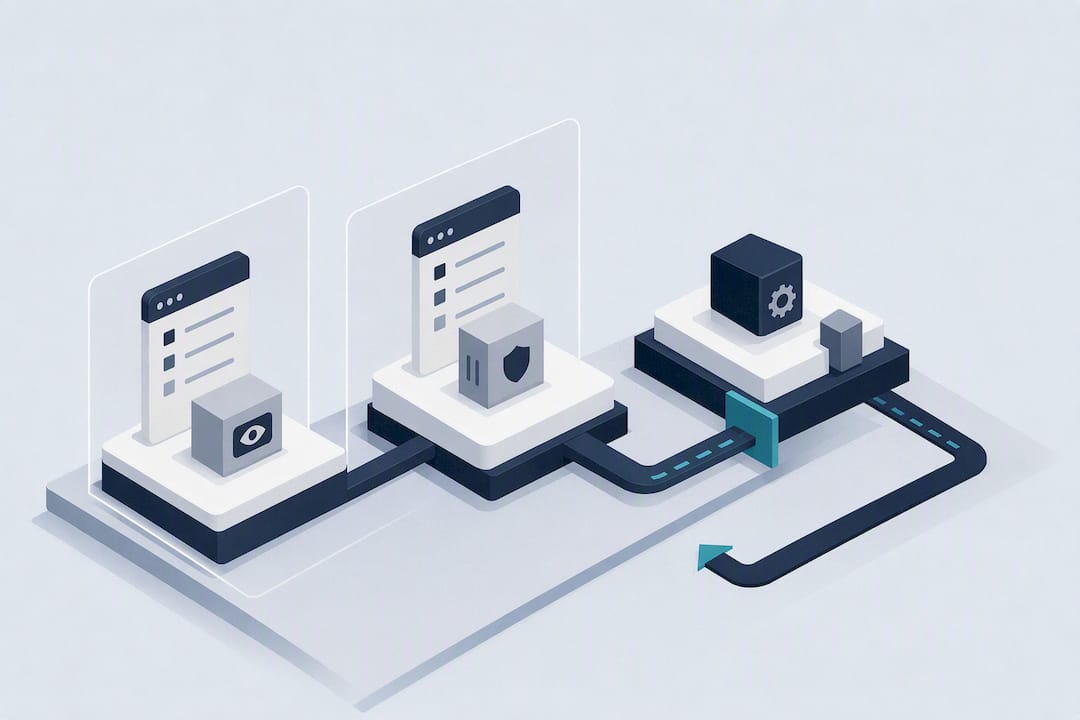
Automated incident response, in the operational sense, means a pipeline that detects, enriches, decides, and acts on production incidents without waiting on a human for every step. The safest posture is phased autonomy: agents observe and diagnose first, then suggest fixes, then execute only bounded, reversible actions under approval gates. AWS DevOps Agent’s investigation output paired with CI-driven remediation through tools like Kiro CLI shows what that looks like in practice, cutting the time between alert and fix without handing agents unchecked write access.
TL;DR:
- Multi-signal confirmation and cross-checking are essential to filter out false positives and ensure automation triggers only real incidents.
- Context enrichment requires ownership data, recent deploy history, and topology maps to make alert data truly actionable.
- Safety measures include mapping autonomy to severity, using ephemeral credentials, requiring signed runbooks, and implementing canary checks with automatic rollbacks.
- A phased rollout plan gradually increases automation levels from observation to controlled autonomy, with continuous testing and validation at each stage.
- Effective metrics include reduced mean time to resolve and investigation speed, balanced with safety KPIs such as false action rate and suggestion accuracy.
Table of Contents
- What Are the Core Components of Automated Incident Response?
- How Do You Keep Automated Remediation Safe?
- What Does a Safe Rollout Plan Look Like?
- Which Metrics Prove Automation Is Working?
- What Do Practitioners Get Wrong About Agentic Ops?
- How Opsphere Fits Into a Safe Automation Strategy
- Sources
What Are the Core Components of Automated Incident Response?
A working pipeline has five layers, and skipping any one of them is usually where teams get burned.
Event ingestion and confirmation. Signals come from CloudWatch or Prometheus alarms, uptime probes, and deployment events from your CI/CD system. A single noisy alert should never trigger action. Multi-signal confirmation, cross-checking a latency spike against error rates and a recent deploy, filters out the false positives that make automation untrustworthy in the first place. This “verification first” discipline is what separates a reliable pipeline from a system that pages on every blip.
Context enrichment. Raw alerts are useless without ownership data, recent deploy history, and a topology map showing which services depend on the failing one. This is the layer most teams underbuild, and it’s also where an operational intelligence layer that already unifies AWS, Kubernetes, and observability data saves the most engineering time.
Decision and runbook layer. Runbook-as-code turns tribal knowledge into versioned, testable logic. Autonomy levels get assigned per runbook, and policy gating (OPA or Gatekeeper are common choices) enforces who or what can approve an action before it fires.
Execution. Actions stay bounded: restart a pod, scale a deployment, roll back a release. A common event-driven pattern chains EventBridge, Lambda, SQS, and CodeBuild so a mitigation plan from an investigation agent lands as a CI job rather than a live production edit.
Evidence and audit. Every action needs an execution ID, a timestamp, and the mitigation payload attached to the incident record. Without this, you can’t tell whether the automation helped or made things worse.
- Ingestion: metrics, logs, deployment events, uptime checks
- Enrichment: ownership, topology, recent changes
- Decision: runbook-as-code with autonomy tiers
- Execution: bounded, reversible actions wired into CI/CD
- Audit: execution IDs, logs, and mitigation payloads attached to every incident
How Do You Keep Automated Remediation Safe?
Safety isn’t a single control. It’s a stack of overlapping guardrails, and each one closes a gap the others miss.
- Map autonomy to severity and action type. A read replica restart in a dev environment can run unattended. A database schema change in production should never run without a human approver, regardless of how confident the agent is.
- Use ephemeral, least-privilege credentials for any write action. Automation should never hold standing production access. Credentials get issued per execution and expire immediately after.
- Require signed runbooks. Only versions that have been reviewed and cryptographically signed get promoted to production, and every execution attaches that signature to the audit log for reproducibility.
- Build canary checks and automatic rollback into every automated action. If the fix doesn’t improve the target metric within a defined window, the system reverts on its own instead of waiting for someone to notice.
- Gate with policy-as-code and multi-approver flows. High-risk actions need more than one sign-off, plus a kill switch that halts all automation instantly if something looks wrong.
Agent transparency matters as much as the gates themselves. Every recommendation an agent produces should cite the specific logs, metrics, or deploy events it used to reach its conclusion, not just a confidence score.
Pro Tip: Treat your kill switch like a fire alarm, not a feature. It should be a single command, tested quarterly, that any on-call engineer can trigger without needing approval from anyone.
What Does a Safe Rollout Plan Look Like?
Jumping straight to autonomous remediation is how teams end up with regressions they didn’t sign up for. A phased plan builds trust incrementally, and each phase has a clear exit criterion before you move to the next one.
Phase 0 to 1: Observe only. Deploy agents that gather context and post it to your incident channel, but they don’t touch anything. Collect suggestion-quality metrics across 30 to 60 incidents before deciding whether the agent’s diagnoses are actually reliable.
Phase 2: Suggest with approval. The agent drafts a pull request or offers a one-click confirmation for low-risk remediations like a service restart. A human still clicks the button.
Phase 3: Scoped automation. Reversible actions run automatically, but every one carries a canary check and an automatic rollback path. This is where most mature teams land for the bulk of their incidents.
Phase 4: Controlled autonomy. Reserved for well-tested, pre-authorized scenarios that have run through staging dry runs, chaos experiments, and synthetic incidents dozens of times. Even here, continuous validation runs in the background.
Testing throughout every phase should include red-team prompts, deliberate attempts to trick the agent into taking a bad action, because production incidents are exactly the kind of high-pressure, ambiguous situations where an under-tested agent fails in unpredictable ways.
- Run staging dry runs before promoting any runbook
- Use chaos experiments to validate rollback paths under real failure conditions
- Inject synthetic incidents to test agent judgment without production risk
- Red-team the agent’s decision logic before granting it any write access
| Phase | Autonomy level | Human involvement |
|---|---|---|
| 0 to 1 | Observe only | Reviews all agent output |
| 2 | Suggest with approval | Approves every action |
| 3 | Scoped automation | Approves canary/rollback thresholds upfront |
| 4 | Controlled autonomy | Reviews post-incident, not per-action |
Which Metrics Prove Automation Is Working?
Two categories of metrics matter, and teams that only track one end up flying blind on the other.
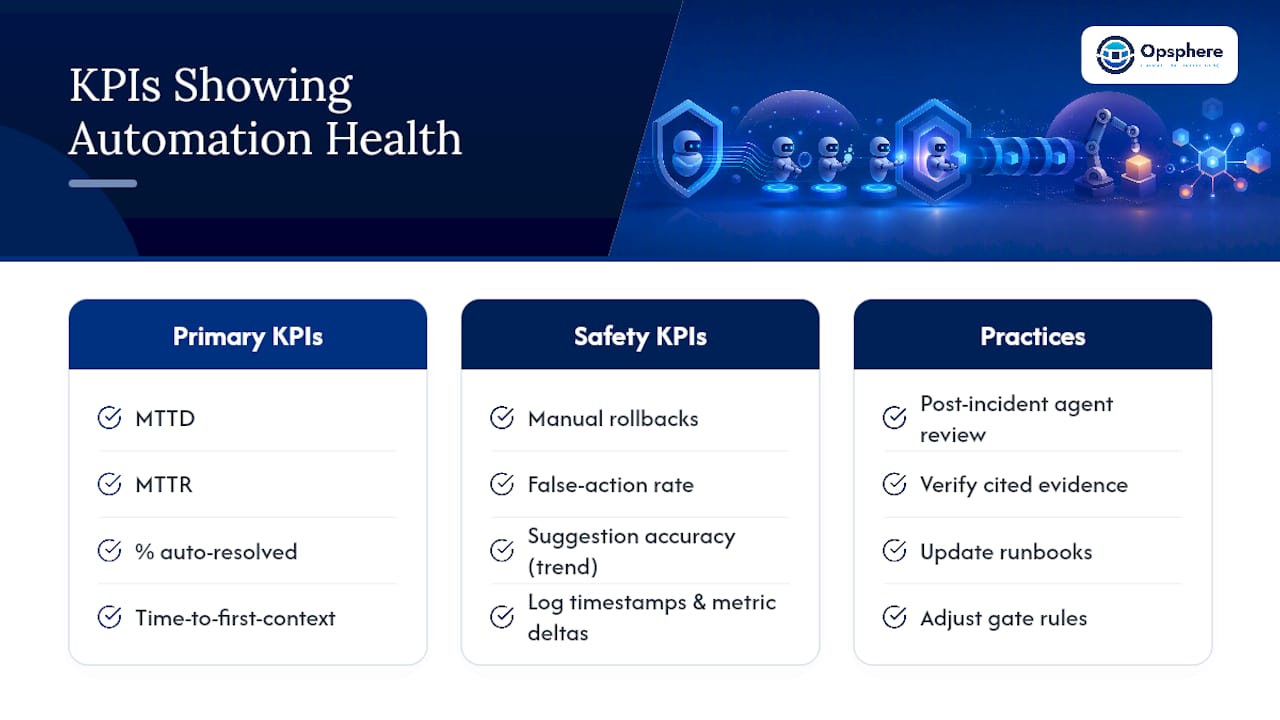
Primary KPIs tell you if automation is actually saving time: mean time to detect (MTTD), mean time to resolve (MTTR), the percentage of incidents auto-resolved without escalation, and time-to-first-context, how long it takes an engineer to get a usable picture of what’s happening. AWS DevOps Agent’s customer previews reported up to 75% lower MTTR and 80% faster investigations, with 94% root cause accuracy in those scenarios. Numbers like that only mean something if you’re also tracking safety.
Safety KPIs catch the failure modes automation introduces: how many manual rollbacks happen after an automated action, the false-action rate, and agent-suggestion accuracy over time. Log every action’s start and end timestamp along with pre- and post-action metric deltas so you can prove, not assume, that a fix actually worked.
Post-incident reviews should include a dedicated look at agent performance. Did it cite the right evidence? Did the runbook need an update? Practitioner reports consistently recommend reviewing the agent itself after every incident and adjusting gate rules based on what actually happened, not what you assumed would happen when you designed the system.
What Do Practitioners Get Wrong About Agentic Ops?
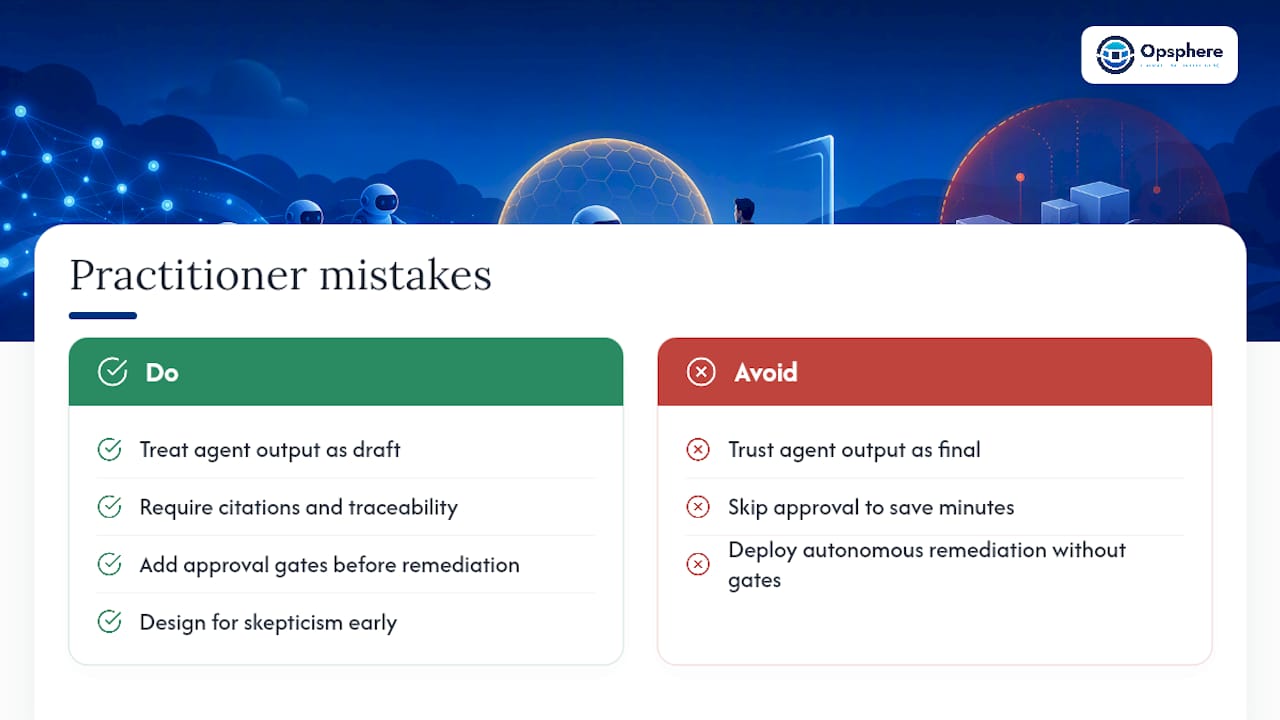
The biggest mistake teams make is treating agent output as a decision instead of a draft. Agents are genuinely strong at gathering context fast and drafting a postmortem, but production experience shows that autonomous remediation without gates has caused real regressions when teams skipped the approval step to save a few minutes.
Trust erodes fast once an agent gets something wrong in public. That’s why citations and traceability in every agent summary aren’t optional polish, they’re what lets an on-call engineer verify a claim in ten seconds instead of re-investigating from scratch. Build for that skepticism from day one, not after the first bad call.
— José
How Opsphere Fits Into a Safe Automation Strategy
Opsphere gives teams the unified context layer that every pattern in this article depends on: service ownership, deploy history, and topology in one place instead of scattered across a dozen dashboards. Its AI agents pull from more than 300 read-only operational tools across AWS, Kubernetes, CI/CD, and observability stacks, so the enrichment and decision layers described above don’t require stitching together custom integrations yourself.
Because some tools are read-only by design, teams can run agentic investigation and suggestion workflows immediately, the observe and suggest phases, without opening up write access before they’re ready. Engineers can query infrastructure state and incident context from the Opsphere Web Client or directly inside their editor through the Cursor IDE integration, keeping remediation review inside the same workflow they already use for code. Platform teams building runbook-as-code templates and approval gates will find the governance controls in the Opsphere Admin Panel map directly onto the phased rollout plan above. If you’re ready to move past scattered dashboards and start Phase 0 with real operational context, request a demo of the Opsphere platform and see what it surfaces on your own infrastructure.
Sources
- Autonomous Agents in Incident Response: Safe Design Patterns
- Agentic Ops — AI Agents for Incident Response