
Edge Delta vs Opsphere: Compare SRE Tools Without Another Agent
Edge Delta vs Opsphere: Compare SRE Tools Without Another Agent

Edge Delta is a telemetry-native AI SRE platform that analyzes telemetry at the edge to detect and investigate incidents before engineers are paged. It processes logs, metrics, and traces close to the source using agents, then surfaces evidence for faster investigations. For teams that want a single operational layer that unifies context across their existing tools rather than adding another edge-processing system, we built Opsphere to be the better fit.
TL;DR:
- Edge Delta agents filter, normalize, and summarize telemetry at its source, reducing egress and indexing load but adding fleet management and peak traffic compute overhead.
- Remediation proposals require human approval, and Edge Delta generally complements existing dashboards by exporting processed data to storage, security, and analytics tools.
- In 2026, Edge Delta removed pipeline throughput charges, while storage and AI token rates require a quote; check whether agents cost extra.
- Choose Edge Delta to reduce egress if your team can manage agents; a unified layer suits teams investigating across multiple clouds and existing tools.
Table of Contents
- Platform overview: telemetry-native AI SRE explained
- Architecture deep dive: agents and telemetry pipelines
- AI SRE capabilities: detection, investigation, and remediations
- Integrations and where Edge Delta fits in a stack
- Pricing and operating costs (including April 2026 change)
- Company background and trust signals
- Edge Delta vs Opsphere: differences, fit, and decision checklist
- Opsphere: how we meet the operational intelligence challenge
- FAQ
- Sources
Platform overview: telemetry-native AI SRE explained
“Telemetry-native” describes a platform built to reason over logs, metrics, traces, and events as its primary data model, rather than bolting AI onto a dashboard product after the fact. “AI SRE” extends that reasoning into detection, investigation, and remediation tasks that used to require a human on call.
Edge Delta’s architecture reflects this design. Agents sit near the data source, analysis backends aggregate findings, and the platform produces investigative artifacts when something looks wrong. The company, covered by TechCrunch’s reporting on its Series A, built this approach specifically to reduce the cost and latency of centralized indexing.
The practical outcomes teams look for:
- Faster detection because agents analyze telemetry as it is generated, not after a batch job indexes it.
- Lower data movement costs since raw telemetry is filtered and summarized before it leaves its origin.
- Investigation artifacts (correlated logs, derived metrics, hypotheses) ready before an engineer opens an incident.
That combination positions Edge Delta as an edge-processing specialist first, with AI SRE capabilities layered on top of a distributed pipeline.
Architecture deep dive: agents and telemetry pipelines
Edge Delta’s telemetry pipelines do their work in place. Instead of shipping every raw log line and metric point to a central store, the pipeline filters, normalizes, and aggregates data close to where it is produced. That changes several operational trade-offs at once: less egress, less centralized indexing load, and lower latency between an anomaly occurring and an agent flagging it.

Agents handle the local analysis. They watch for pattern shifts, build derived artifacts (rollups, graphs, anomaly scores), and package evidence that an investigation can use immediately rather than reconstructing it after the fact from raw data.
Key architectural behaviors:
- Processing happens at the edge, so raw telemetry rarely has to travel before it is summarized.
- Derived artifacts (not just raw events) become the primary evidence used in an investigation.
- Fleet management and compute footprint become real operational concerns since agents run everywhere telemetry originates.
Pro Tip: Before standardizing on an edge-processing agent, test its CPU and memory footprint at your actual peak traffic, not a synthetic benchmark, since agent overhead scales with the volume and cardinality of what it’s watching.
The operational implication is straightforward: edge processing reduces centralized cost and speeds up detection, but it shifts some of that cost into managing a distributed agent fleet, versioning rules, and validating that the summarized artifacts are faithful to the raw telemetry they replace, as explored in detail in data-flow analysis for engineering teams.
AI SRE capabilities: detection, investigation, and remediations
The AI layer is where Edge Delta tries to change what an on-call engineer actually does. Rather than waiting for a threshold-based alert, agents continuously analyze telemetry patterns and can start building an investigation before a page ever fires.
- Detection: Agents watch for anomalies in logs, metrics, and traces, flagging deviations from expected baselines as they occur at the edge.
- Investigation: When an anomaly is flagged, the platform assembles evidence, linked logs, correlated metrics, relevant traces, and a working hypothesis about the likely cause.
- Remediation: Based on that evidence, the platform can propose a fix or workflow, but the step from proposal to execution typically still requires human approval.
That last point matters for any team evaluating autonomy claims. Public statements from Edge Delta’s CEO have framed the goal as shifting SREs from reactive responders toward active decision-makers, with agents doing the preparatory work rather than replacing human judgment entirely. The practical result is an engineer who starts an incident with context already assembled instead of starting from a raw alert and a blank dashboard.
Integrations and where Edge Delta fits in a stack
Edge Delta rarely operates as a team’s only pane of glass. It is commonly deployed as a layer that forwards processed, derived telemetry to the destinations a team already relies on for long-term storage, search, or compliance.
Typical integration patterns include:
- Exporting summarized or derived telemetry to SIEMs for security and compliance workflows.
- Routing processed data to data warehouses or object storage like S3 for long-term retention.
- Feeding existing dashboards and analytics tools so visualization doesn’t have to be rebuilt from scratch.
Industry coverage of edge-processing vendors generally describes this pattern: dashboard maturity varies across these tools, so many teams pair edge processing with the visualization layer they already trust, treating it as a complementary intelligence source rather than a full replacement for centralized analytics.
Pricing and operating costs (including April 2026 change)
Edge Delta’s billing historically combined data stored, AI token consumption, and a per-GB throughput charge for data moving through its pipelines. That structure meant cost scaled directly with telemetry volume, which made budgeting harder for teams with spiky or high-cardinality workloads.
In 2026, Edge Delta changed its pricing model to eliminate charges for telemetry pipelines at any scale, according to reporting by APMdigest, shifting the billable cost structure toward stored data and AI token usage instead of throughput. That change removes a major variable cost for teams with high-volume pipelines, though per-unit rates for storage and tokens remain quote-only.
Before committing to any platform’s billing model, check:
- How storage costs scale as retention windows grow.
- How AI token consumption is metered, and whether investigation-heavy workloads drive it up quickly.
- Whether agent compute (CPU, memory, licensing per host) is billed separately from the platform itself.
Company background and trust signals
Edge Delta is a Seattle-based, venture-backed company founded in 2018, built around the telemetry-native AI SRE thesis described above. According to its PitchBook company profile, the company has raised $82 million in total funding and employs approximately 92 people as of 2026.
For teams doing vendor diligence, useful verification points include:
- Funding history and investor composition, documented in the PitchBook profile.
- Early-stage coverage of the company’s product thesis and fundraising, available through TechCrunch’s Series A report.
- Marketplace listings (AWS Marketplace and similar channels) that confirm deployment options and packaging.
Edge Delta vs Opsphere: differences, fit, and decision checklist
The core architectural difference is where the work happens. Edge Delta processes telemetry at the edge, close to where logs, metrics, and traces originate, then forwards derived artifacts outward. We built Opsphere as a unified operational layer that sits across the tools teams already run (AWS, Kubernetes, observability stacks, CI/CD, and security tooling) and investigates using the context already present in those systems, without requiring teams to duplicate or replace their existing telemetry pipeline.
That distinction shapes how each platform handles investigation and governance:
- Architecture: Edge Delta’s edge-first pipeline reduces egress and indexing costs; Opsphere’s unified layer connects to systems of record directly so each tool stays the source of truth.
- Investigation workflow: Edge Delta packages evidence from processed telemetry; Opsphere’s evidence-backed investigations test parallel hypotheses against live operational context and retain memory across incidents.
- Governance: Edge Delta’s remediation proposals require human approval before execution; Opsphere maintains strict read-only access patterns by design, with more than 300 operational tools available through its Model Context Protocol gateway.
Pro Tip: If your team already has a telemetry pipeline you trust and wants to add edge filtering to cut egress costs, that’s a narrower, infrastructure-level decision. If you want one place to investigate across tools you already run without re-architecting ingestion, that’s a platform-level decision, and it points toward a different kind of tool.
Teams with simple, single-source telemetry and a strong appetite for managing a distributed agent fleet may find Edge Delta’s edge-first approach fits. Teams juggling multiple clouds, Kubernetes clusters, and a sprawling toolchain who want investigations grounded in the systems they already trust tend to be better served by a unified layer.
Opsphere: how we meet the operational intelligence challenge
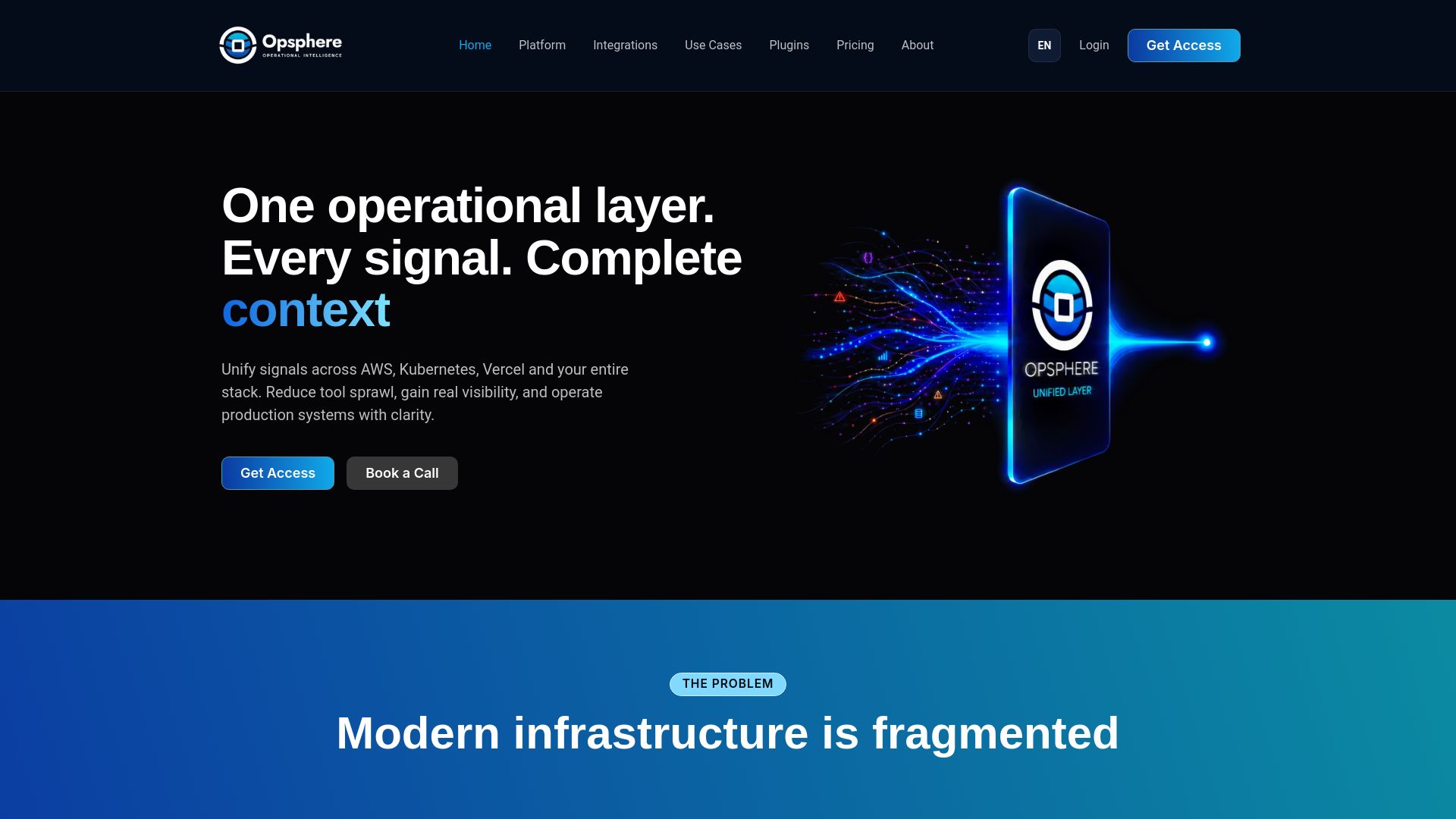
We built Opsphere as an AI-powered operational layer that connects to the tools teams already run instead of asking them to replace their telemetry pipeline. That means no duplicated ingestion, no second source of truth to reconcile, and investigations that start from the context already sitting in your AWS, Kubernetes, CI/CD, and security tools.
What that looks like in practice:
- Evidence-backed investigations that test multiple hypotheses in parallel and retain context across incidents, detailed on our investigations page.
- A Model Context Protocol gateway connecting more than 300 read-only operational tools, explained on our MCP gateway page.
- Plans for individuals and teams of every size, from the free Community tier to Developer at €19 per month, Team at €500 per month, and Enterprise at €450 per month.
If your stack already spans multiple clouds and tools, see how we fit platform engineering teams or try the Opsphere web client directly.
FAQ
What makes a platform “telemetry-native”?
A telemetry-native platform is built to reason directly over logs, metrics, traces, and events as its core data model, rather than adding analysis on top of a traditional dashboard. Edge Delta applies this by running agents that analyze telemetry locally before any central aggregation happens.
How does Edge Delta’s edge processing reduce costs?
Edge Delta filters and summarizes telemetry near its source, which cuts the volume of raw data that has to travel to central storage or indexing. Industry reporting has described this as a way to reduce the total cost of centralized indexing, though actual savings vary by workload, as TechCrunch noted.
What changed in Edge Delta’s pricing in 2026?
In 2026, Edge Delta changed its pricing model to eliminate charges for telemetry pipelines at any scale, removing the per-GB throughput charge that previously applied to data moving through its pipelines, according to APMdigest. Billing now centers on stored data and AI token consumption instead.
When should a team choose a unified operational layer instead of an edge processor?
A unified layer makes sense when a team already runs multiple clouds, Kubernetes clusters, and a mix of observability and security tools and wants investigations grounded in that existing context without duplicating ingestion. Opsphere was built for exactly that case, connecting to tools you already use rather than replacing your telemetry pipeline.
Does Edge Delta replace existing dashboards and visualization tools?
Edge Delta is typically deployed alongside existing dashboards rather than as a full replacement, since dashboard maturity varies across edge-processing vendors. Many teams use it as a complementary intelligence layer that feeds processed telemetry into the visualization tools they already trust.
Sources
- Edge Delta 2026 Company Profile: Valuation, Funding & Investors | PitchBook
- Edge Delta raises $15M Series A to take on Splunk | TechCrunch
- Edge Delta makes all telemetry pipelines data throughput limitless and free | APMdigest
This article is provided for general informational purposes only and does not constitute professional, legal, security, or compliance advice. Please evaluate recommendations against your organization’s specific environment and requirements.