
Draft First, Run in 30–60 Minutes: Blameless Postmortems for SREs
Draft First, Run in 30–60 Minutes: Blameless Postmortems for SREs

A blameless postmortem is a structured, non-punitive incident review that focuses on system and process fixes, not individual fault. The goal isn’t absolution, it’s better data: teams that remove blame get more honest timelines, catch systemic weaknesses faster, and see fewer repeat incidents. Doing it well requires psychological safety and explicit facilitation rules, not just a well-intentioned label on the meeting invite.
TL;DR:
- Drafts should be completed within 24 to 48 hours to ensure accurate reconstruction and avoid memory degradation, facilitating faster review sessions.
- The postmortem review must focus on system and process failures rather than individual mistakes, with clear, non-blaming language around contributing factors.
- Facilitators should strictly enforce the Prime Directive and guide discussions with “what” and “how” questions to prevent blame and promote system-wide learning.
- Linking the postmortem directly to incident data, logs, and tracking tools increases consistency, reduces work, and helps identify recurring systemic issues across multiple incidents.
- Using a unified operational view can significantly cut postmortem preparation time by consolidating alerts, logs, and topology for better context and faster timeline assembly.
Table of Contents
- What a Blameless Postmortem Actually Covers
- Why Blamelessness Matters: Principles and Psychological Safety
- Who Writes the Postmortem, and When
- A Postmortem Template You Can Copy Today
- Facilitating the Meeting Without Letting Blame Creep Back In
- Turning Findings Into Tracked Action
- Where Blamelessness Breaks Down in Practice
- How Opsphere Fits Into a Faster Postmortem Process
- Handling Sensitive or High-Impact Incidents
- Connecting Postmortems to Your Incident Management Stack
- Two Experiments Worth Running This Month
- Reduce Postmortem Toil With a Unified Operational View
- Sources
What a Blameless Postmortem Actually Covers
A blameless postmortem is a written, structured review of an incident that examines what happened, why the systems and processes allowed it to happen, and what needs to change to prevent recurrence. It differs from a punitive review in one core way: it treats the incident as evidence of a gap in tooling, process, or documentation rather than a failure of judgment by a specific person. Google’s SRE postmortem culture assumes engineers acted with the best intentions given the information they had at the time, which reframes the entire exercise around learning instead of punishment.
Not every hiccup deserves a full postmortem. Most teams reserve them for incidents that clear a specific bar:
- User-visible outages that breach a service level agreement or cross a defined severity threshold
- Data loss or corruption incidents, regardless of their scale
- Security incidents, including near-misses without resulting breaches
- Repeated failures of the same component, even if individual incidents have low severity
“Blameless” doesn’t mean “consequence-free.” Someone still owns the follow-up work, and the organization still holds itself accountable for fixing what broke. The distinction is that accountability attaches to the fix, not to the person who happened to be on call.
Why Blamelessness Matters: Principles and Psychological Safety
Blameless review isn’t a soft HR add-on. It’s a mechanism for getting accurate information out of people who might otherwise hide it. Engineers who fear disciplinary consequences tend to under-report near-misses, soften timelines, and omit the exact command they ran right before things broke. That’s precisely the detail a postmortem needs.
Two cognitive biases explain why blame creeps in even when nobody intends it. Fundamental attribution error leads people to blame a colleague’s character or competence for a mistake, while excusing their own errors as situational. Hindsight bias makes a bad outcome look obvious in retrospect, even though the person who caused it was working with incomplete information in the moment. Both biases push a review toward “who screwed up” instead of “what let this happen.” Naming them out loud during a meeting is often enough to redirect the conversation.
Norm Kerth’s Retrospective Prime Directive puts this into a single sentence teams can read aloud at the start of a review: regardless of what is discovered, everyone did the best job they could, given what they knew at the time, their skills, the resources available, and the situation at hand. Reading it isn’t a formality. It sets the ground rule that the meeting will interrogate the situation, not the person.
Pro Tip: If your team is new to blameless reviews, print the Prime Directive and read it verbatim before every postmortem for the first few months. Skipping it because “everyone already knows the drill” is how the habit quietly erodes.
Who Writes the Postmortem, and When
The single biggest predictor of a useful postmortem meeting is whether a draft existed before anyone walked into the room. A meeting that starts with a blank page turns into collaborative timeline reconstruction, which is slow, exhausting, and prone to groupthink. A meeting that starts with a draft becomes a validation and prioritization exercise, which is faster and produces sharper action items.
- Assign an author immediately after the incident closes. This is usually the incident commander or whoever had the clearest end-to-end view of the response. They own the first draft, not the final conclusions.
- Draft the timeline, impact, and initial contributing factors within 24 to 48 hours. Memory degrades fast; logs and Slack threads are still fresh at this point but get harder to reconstruct after a few days.
- Circulate the draft, agenda, and supporting artifacts before the meeting. Reviewers should read the draft in advance, not encounter it live.
- Bring in reviewers who weren’t in the incident’s blast radius. Senior engineers and product or operations leads who can challenge assumptions add more value than people defending their own actions.
- Run the meeting to stress-test the draft, not write it from scratch. The agenda item isn’t “what happened” (that’s already written down); it’s “is this timeline accurate, and what are we missing in the causal analysis.”
Practitioners across the SRE community consistently push this draft-before-meeting discipline because writing collaboratively in real time wastes expensive senior engineering hours on a task one person could have finished the day before.
A Postmortem Template You Can Copy Today
A usable postmortem template doesn’t need to be elaborate. It needs consistent fields that make the document scannable six months later when someone is trying to spot a pattern across five different incidents. FireHydrant’s guidance on blameless retrospectives converges on the same core structure most mature SRE organizations already use: impact, timeline, contributing factors, and tracked action items.
- Summary: Two or three sentences covering what broke, how it was detected, and how it was resolved.
- Impact: Who was affected, for how long, and by what measure (failed requests, revenue impact, degraded latency).
- Timeline: Timestamped sequence of detection, escalation, mitigation, and resolution, in UTC to avoid time zone confusion.
- Contributing factors: The conditions that allowed the incident to happen, not the person who triggered it. Write “the deploy pipeline lacked a canary stage” instead of “the engineer skipped canary testing.”
- Action items: Each one tagged as prevent (stops recurrence), mitigate (reduces impact if it happens again), or observe (improves detection), with an owner, priority, and due date.
- Verification criteria: How you’ll confirm each action item actually worked, not just that it was completed.
Wording is where blameless intent either holds up or falls apart. Compare “the on-call engineer missed the alert” with “the alert routing sent a page to a channel nobody was monitoring during the shift handoff.” Same fact, different accountability target.
| Template Field | What It Captures | Common Mistake |
|---|---|---|
| Summary | The incident in plain language | Burying the real impact in jargon |
| Timeline | Timestamped sequence of events | Missing the detection gap before escalation |
| Contributing factors | System and process conditions | Naming a person instead of a condition |
| Action items | Prevent, mitigate, or observe fixes | No owner or due date attached |
| Verification | Proof the fix actually worked | Marking “done” without confirming impact |
Facilitating the Meeting Without Letting Blame Creep Back In
Even a well-written draft can turn into a blame session if the facilitator loses control of the room. The meeting format matters as much as the document.
- Open with the Prime Directive and state the ground rules out loud. Nobody is on trial; the meeting exists to validate the draft and sharpen action items.
- Set a hard timebox, typically 30 to 60 minutes depending on severity. A meeting that drags past an hour usually means the draft wasn’t solid enough going in.
- Ask “what” and “how” questions, never “why” or “who.” PagerDuty’s blameless postmortem guidance frames this as the single most effective facilitation rule: “what did the monitoring show at that point” gets a factual answer, while “why didn’t you check the dashboard” invites defensiveness.
- Watch for defensiveness and redirect toward mutual purpose. If someone starts justifying a decision instead of describing it, the facilitator should name what’s happening and steer back to the system.
- Offer anonymized input channels for sensitive details. A shared doc or async survey where people can flag contributing factors without attribution works well for newer teams or ones with visible power imbalances.
Pro Tip: Keep a facilitator’s script on hand for the first few meetings: “Let’s stick to what the system did and how we responded, we can workshop process changes after we agree on the timeline.” Saying it verbatim, even if it feels scripted, protects the room better than improvising in the moment.
Anonymity isn’t a permanent crutch. It’s a bridge for teams still building trust, and most organizations phase it out once psychological safety is established.
Turning Findings Into Tracked Action
A postmortem that generates insight but no follow-through is worse than no postmortem at all, because it burns goodwill and teaches people the exercise doesn’t matter. Every action item needs three things to survive past the meeting: an owner, a verification method, and a place where someone will actually check on it.
- Assign one specific owner per action item rather than a team or an unspecified person
- Attach verification criteria that prove the fix worked, not just that a ticket got closed.
- Regularly review progress on open action items according to incident severity, such as weekly for high-severity incidents and less frequently for others
- Track incident recurrence separately from task completion to ensure fixes address root causes effectively
Three metrics tell you whether your postmortem process is actually working: action completion rate within the committed timeframe, incident recurrence rate for the same root cause, and trend lines on MTTA and MTTR over successive quarters. If completion rates are high but recurrence keeps happening, the postmortems are producing busywork instead of fixes. If MTTA is dropping but recurrence isn’t, your team is getting faster at responding to the same problem instead of eliminating it.
Where Blamelessness Breaks Down in Practice
Most postmortem programs don’t fail because leadership rejects the concept. They fail because a handful of habits quietly reintroduce blame or drain the process of consequence.
- Blame-shifting to another team or a vendor’s tooling. “The database team’s config caused this” is still an attribution statement dressed up as a systems finding.
- Root-cause fixation. Complex incidents rarely have one root cause; stopping at the first plausible explanation misses the contributing factors that will cause the next incident.
- Postmortems that get written and archived, never actioned. A document with no owner checking progress is a formality, not a review.
- Accusatory or personal language in the writeup itself. “John forgot to update the runbook” belongs nowhere in a document meant to outlive the person’s memory of the incident.
- Skipping anonymization when power imbalances are obvious. A junior engineer reviewing a senior architect’s decision needs a way to raise concerns without attaching their name to it.
How Opsphere Fits Into a Faster Postmortem Process
Most of the time lost in postmortem prep isn’t analysis, it’s reconstruction: stitching together logs from one tool, metrics from another, and a deploy history from a third just to build an accurate timeline. A unified operational view that consolidates alerts, logs, and topology can shorten the reconstruction phase considerably.
For small SRE teams without the headcount to babysit five monitoring dashboards during an incident, that consolidation matters even more during the postmortem than during the incident itself. E-commerce microservices architectures, where a single checkout failure can cascade across a dozen services, benefit from the same clarity: a unified topology view makes it obvious which service actually triggered the cascade instead of guessing from scattered dashboards. When runbook context sits next to the incident timeline, ownership questions that used to eat up meeting time get answered before the meeting starts.
Handling Sensitive or High-Impact Incidents
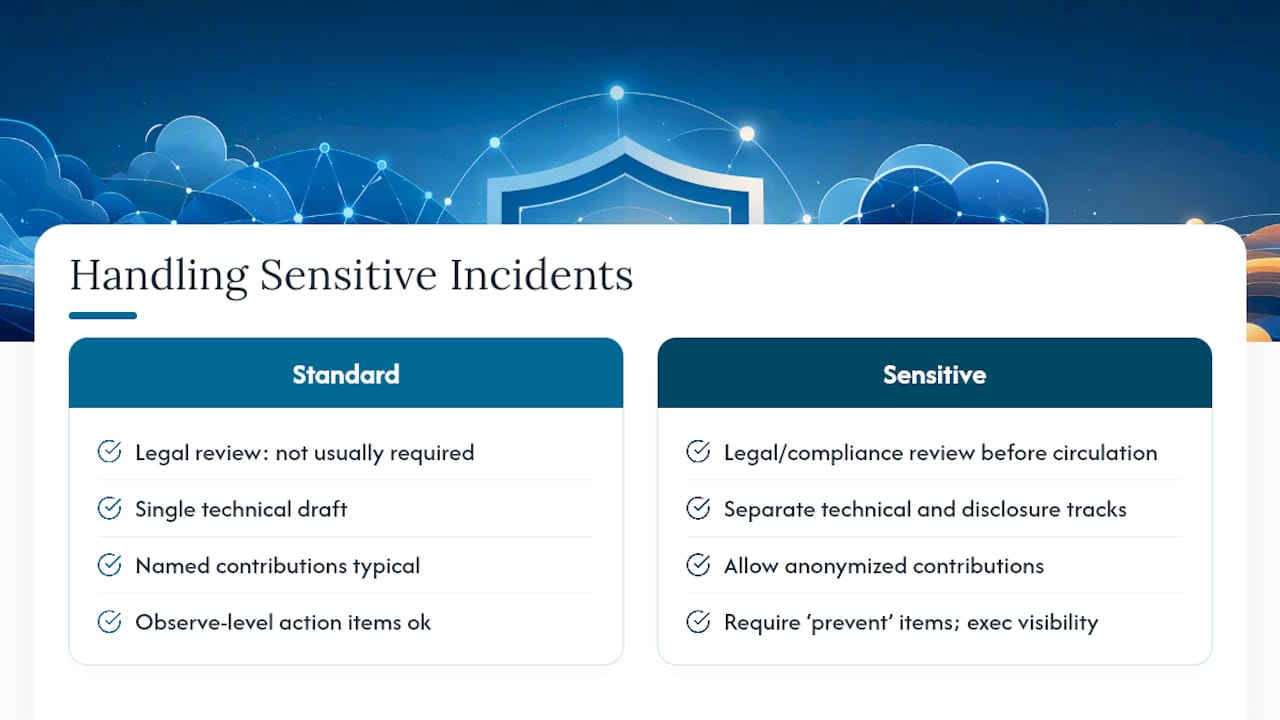
Data loss, security breaches, and incidents involving customer harm need a modified version of the standard process, not a different one entirely. The core principles hold, but a few adjustments protect both the investigation and the people involved.
Legal and compliance stakeholders often need to review the draft before wider circulation, particularly for security incidents where details might be relevant to a disclosure obligation. This doesn’t mean the postmortem becomes a legal document; it means the technical draft and the disclosure narrative may need to be handled on separate tracks with separate audiences.
Anonymized input becomes more valuable, not less, for high-impact incidents. When an incident involves a visible mistake by a specific engineer, that person is often the most anxious participant in the room. Giving them a way to contribute detail without their name attached to every sentence in the shared document reduces the temptation to omit information out of self-protection.
Severity should also change your action-item bar, not your facilitation rules. A minor incident might tolerate an “observe” action item that just improves alerting. A data-loss incident usually needs at least one “prevent” item with executive visibility on its due date. The facilitation script stays the same: ask what happened and how the systems responded. What changes is the intensity of follow-through tracking and who gets copied on the final document.
Connecting Postmortems to Your Incident Management Stack
A postmortem written in isolation from your monitoring and incident management tools is starting from a disadvantage. The timeline reconstruction, the impact numbers, and the contributing factors all live somewhere in your existing stack already, they just need to be pulled together.
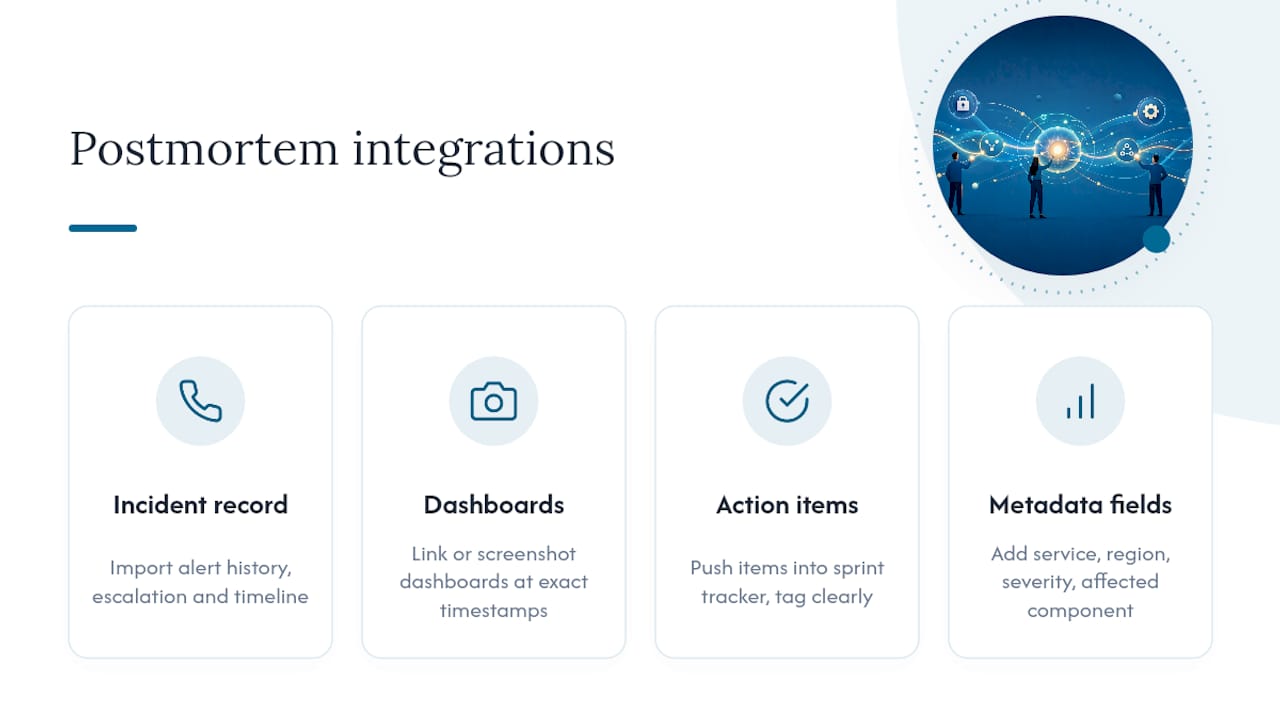
Most mature incident programs link the postmortem document directly to the incident record in their paging tool, so the alert history, escalation path, and response timeline import automatically instead of getting retyped from memory. Monitoring dashboards should be screenshotted or linked at the exact timestamps referenced in the timeline, not summarized from memory days later. Action items that come out of a postmortem work best when they land directly in the same tracker your team already uses for sprint work, tagged clearly so they don’t get lost among unrelated backlog items.
The metadata fields worth adding to every postmortem, service name, region, severity level, and affected component, do more than organize a single document. They let you aggregate findings across dozens of postmortems and spot patterns no single incident review would reveal on its own, like a particular service that shows up as a contributing factor across five unrelated incidents in six months.
Two Experiments Worth Running This Month
Start small. Enforce the draft-before-meeting rule for one incident severity tier and see how much shorter your meetings get. Separately, try offering an anonymized input form for your next high-severity postmortem, even if your team has never used one before, and compare the detail you get against your last few meetings.
Measure both by two things: action item completion rate over the following month, and a short anonymous survey asking whether people felt safe raising uncomfortable details. Leadership needs to visibly reinforce this, not just approve it in a policy doc. A manager who thanks someone publicly for flagging their own mistake does more for the culture than any written policy ever will.
— José
Reduce Postmortem Toil With a Unified Operational View
Writing a clean postmortem timeline gets a lot easier when the data isn’t scattered across five dashboards to begin with. Opsphere normalizes signals from AWS, Kubernetes, and the rest of your stack into one operational view, so the timeline reconstruction that usually eats the first hour of postmortem prep shrinks to minutes.
Small SRE teams and e-commerce microservices setups get the most out of this, since they’re the ones most likely to be stitching together context from tools that were never designed to talk to each other during an incident review. Instead of exporting logs from one system, alert history from another, and topology from a third, the Opsphere platform gives you a single source of truth to build the draft from before anyone walks into the meeting. If your postmortems keep stalling on “what actually happened,” start with the Opsphere web client and see how much of your prep time it gives back.
Sources
- Blameless Postmortem for System Resilience — Google SRE
- The Blameless Postmortem — PagerDuty
- The Retrospective Prime Directive — Catapult Labs
- What are blameless retrospectives? How do you run them? — FireHydrant