
Self Healing Infrastructure for SREs: Evidence Chains, GitOps Safety
Self Healing Infrastructure for SREs: Evidence Chains, GitOps Safety

Self-healing infrastructure combines observability, AI-assisted diagnosis, and declarative automated remediation, guarded by governance controls that keep humans in the loop when it counts. The result is lower mean time to resolution and infrastructure that degrades predictably instead of failing outright. Start small: pick one narrow, low-risk automation, wire it to real evidence, and prove reversibility before you scale.
TL;DR:
- Automated responses should progress from alerting to fully autonomous diagnosis and fix only once the system demonstrates reliability and safety measures are in place.
- Reliable self-healing systems prioritize redundancy, self-preservation, and graceful degradation before automating remediation, preventing automation around unresolved gaps.
- Evidence chains linking logs, metrics, and topology are essential for trustworthy diagnosis and must be included with every automated action to ensure proper post-mortem analysis.
- Deploying self-healing in stages—starting with low-risk, repeatable fixes and using PR-based workflows—reduces risk and builds confidence in automation.
- Effective automation relies on queryable, integrated observability infrastructure and strict governance controls like prediction gates, reversible actions, and auditability.
Table of Contents
- What Does Self-Healing Infrastructure Mean in Practice?
- Design Principles: Redundancy, Self-Preservation, and Graceful Degradation
- Observability and Detection: What to Instrument and Why
- Automated Remediation Patterns and Agent Architectures
- Safety, Governance, and Reversibility
- How to Build a Self-Healing Infrastructure Pilot
- A Concrete Autonomous SRE Agent Pattern
- Where Teams Get Self-Healing Automation Wrong
- Building the Evidence Chain Behind Governed Automation
- Sources
What Does Self-Healing Infrastructure Mean in Practice?
Not every automated response counts as self-healing. There’s a real difference between three tiers of maturity, and confusing them is where most platform teams overpromise to leadership.
- Monitoring and alerts: a human sees a signal and acts. No automation, just faster awareness.
- Remediating automation: a fixed script fires on a known condition, like restarting a pod on a memory threshold.
- Closed-loop autonomy: an agent observes, diagnoses a root cause, proposes or applies a fix, and verifies the outcome, without a human writing the runbook step by step.
The goal across all three tiers is the same: shrink MTTR, contain blast radius, and make degraded states predictable rather than chaotic. AI’s job here is augmentation, not authority. It speeds up diagnosis and drafts a remediation plan, but the actual authority to change production should sit behind the same governance gates you’d demand of a human on-call engineer, if not tighter ones.
Design Principles: Redundancy, Self-Preservation, and Graceful Degradation
Microsoft’s Well-Architected guidance frames reliability around three pillars: redundancy, self-preservation, and automated recovery. Each maps to a concrete architectural decision, not just a design principle on a slide.
- Choose the right redundancy level. Availability zones cover hardware failure. Regions cover a provider outage. Deployment stamps isolate customer-scoped blast radius. Bulkheads stop one noisy tenant from starving shared resources.
- Design for self-preservation first. Before you build automated recovery, remove single points of failure and define what the system does when it can’t fully recover. That means deciding, in advance, what “acceptable degraded” looks like for each service tier.
- Build graceful degradation into the code, not the incident response. Feature flags let you shed non-critical functionality under load. Read-only fallbacks keep a service answering queries even when writes are unsafe. Checkpointing lets a long-running job resume instead of restarting from zero.
The order matters. Teams that jump straight to automated remediation without self-preservation end up automating around gaps instead of closing them, which is how a “self-healing” system quietly turns into a system that hides failure until it compounds.
Observability and Detection: What to Instrument and Why
Automated decisions are only as trustworthy as the evidence behind them. That evidence needs to cover four layers:
- Metrics for the quantitative baseline (latency, error rate, saturation).
- Logs for the qualitative detail metrics miss.
- Traces for causal sequence across services.
- A topology or asset graph so an agent (or an engineer) knows what depends on what before acting.
Anomaly detection and root cause analysis pipelines sit on top of that stack, and they need contextual, queryable access to actually reason well. This is where a Model Context Protocol style approach matters: agent projects like AXIOM rely on read-only MCP-style servers to pull context from logs, metrics, and terminals before proposing any action, rather than acting on a single alert in isolation.
Every automated action should carry an evidence chain: the specific logs, metrics, and topology facts that justified it, stored alongside the action itself. Without that chain, a post-mortem six weeks later becomes archaeology instead of analysis, and nobody can tell whether the agent got lucky or got it right.

Pro Tip: Before you trust an agent’s root cause claim, check whether it cites the specific query results it used. If it can’t point to the evidence, treat the diagnosis as a hypothesis, not a finding.
Automated Remediation Patterns and Agent Architectures
The most reliable agent designs borrow the OODA loop, observe, orient, decide, act, from military decision theory, and apply it to SRE work with tool calls instead of radio chatter.
- Observe: the agent queries MCP-style read-only tools for current state, logs, and metrics.
- Orient: it correlates signals against the topology graph to isolate a probable root cause.
- Decide: it drafts a remediation, ideally as a declarative change (a pull request, a Terraform diff, a Kubernetes manifest patch), rather than an in-place edit.
- Act: the change goes through the normal GitOps reconcile path, so the audit trail is the same one you’d use for a human-authored PR.
AXIOM’s own demonstration runs report end-to-end remediation, from alert to applied fix, in under 90 seconds in controlled scenarios. That speed is only safe because the loop includes dry-run checks, schema validation on any structured output, and hard iteration caps that stop an agent from retrying a failed fix indefinitely. Kube-AutoFix, for instance, enforces namespace locks and max-retry limits specifically to prevent a diagnosis error from becoming a cascading one.
Prefer declarative repairs over direct edits every time. A pull request can be reviewed, diffed, and reverted. An in-place kubectl patch at 3 AM cannot.
Safety, Governance, and Reversibility
Governed autonomy rests on three mechanisms, and skipping any one of them is how a promising pilot turns into an incident of its own.
- Fail-closed prediction gates. Before acting, the agent commits a prediction of blast radius and confidence. Below a threshold, it escalates to a human instead of guessing.
- Reversibility by construction. Repairs applied as GitOps commits or NixOS generation switches can be rolled back atomically, the same way you’d revert any bad deploy.
- Tamper-evident auditability. Every action needs a mechanical verdict, a pass or fail check against the predicted outcome, logged in a way that can’t be quietly edited after the fact.
Governed-autonomy platforms like Territory Grounder use a three-band model, AUTO, AUTO_NOTICE, and POLL_PAUSE, plus an immutable “never-auto” floor for changes that simply can’t be reversed. That floor is the real safety net: it’s not about how smart the agent is, it’s about what it’s structurally forbidden from doing alone.
CISA’s Infrastructure Resilience Planning Framework applies the same logic at a systemic level: assess risk, prioritize action, and integrate resilience into planning decisions rather than bolting it on after an outage.
How to Build a Self-Healing Infrastructure Pilot
Adoption works best as a staged climb, not a leap. Puppet’s guidance on incremental self-healing adoption recommends starting with repetitive, low-risk fixes stored in version control, then expanding as confidence and test coverage grow.
- Pick one narrow automation. A known, repeatable failure mode, like a stuck pod or a stale cache, is a better first target than a novel diagnosis problem.
- Instrument observability first. No agent should act without metrics, logs, traces, and a topology map already in place.
- Ship the fix as a pull request. Let a human merge it for the first several cycles before granting auto-merge on narrow conditions.
- Add the evidence chain and gated actuation. Once the PR flow is trusted, gate broader actions behind confidence thresholds.
- Scale with chaos experiments. Test the healing loop against injected failures in staging before it ever meets production traffic.
Pro Tip: Run your first automated fix in shadow mode, logging what it would do without executing, for at least a week. It’s the cheapest way to catch a bad diagnosis before it touches anything.
A Concrete Autonomous SRE Agent Pattern
Open-source projects like AXIOM, vigil, and Kube-AutoFix converge on a similar architecture worth studying directly.
- An MCP-style evidence server exposes read-only access to logs, metrics, and git history.
- An agent runs the OODA loop, querying evidence, forming a hypothesis, and drafting a declarative fix.
- The fix ships as a pull request or a GitOps commit, never a direct write to the cluster.
- A watchdog verifies the outcome mechanically and can trigger an automatic revert if the fix doesn’t resolve the original signal.
- Safety limits, namespace locks, iteration caps, deterministic prompts, keep the loop from spiraling on ambiguous failures.
Expect real gains on well-understood, repeatable failures: stuck deployments, resource exhaustion, config drift. Novel, multi-service failures still need a human in the loop, and any team claiming otherwise hasn’t hit that case yet.
Where Teams Get Self-Healing Automation Wrong
The biggest trap isn’t under-automating, it’s automating the wrong layer first. Teams reach for full autonomy before they’ve built the evidence chain to trust it, then walk it back after one bad auto-remediation.
Brittle, monolithic rules age worse than manual runbooks because nobody remembers why they exist until they misfire. Small SRE teams do best starting with PR-based fixes for known failure modes, and treating rollback paths as a requirement, not an afterthought, from day one.
— José
Building the Evidence Chain Behind Governed Automation
Every pattern in this guide, evidence chains, declarative repairs, gated actuation, depends on having unified, queryable context across your stack before an agent ever proposes a fix. That’s the gap a single operational layer connecting AWS, Kubernetes, observability, CI/CD, and security tooling through AI Agents and MCP-style read-only integrations, so every diagnosis is traceable back to the logs, metrics, and topology facts behind it.
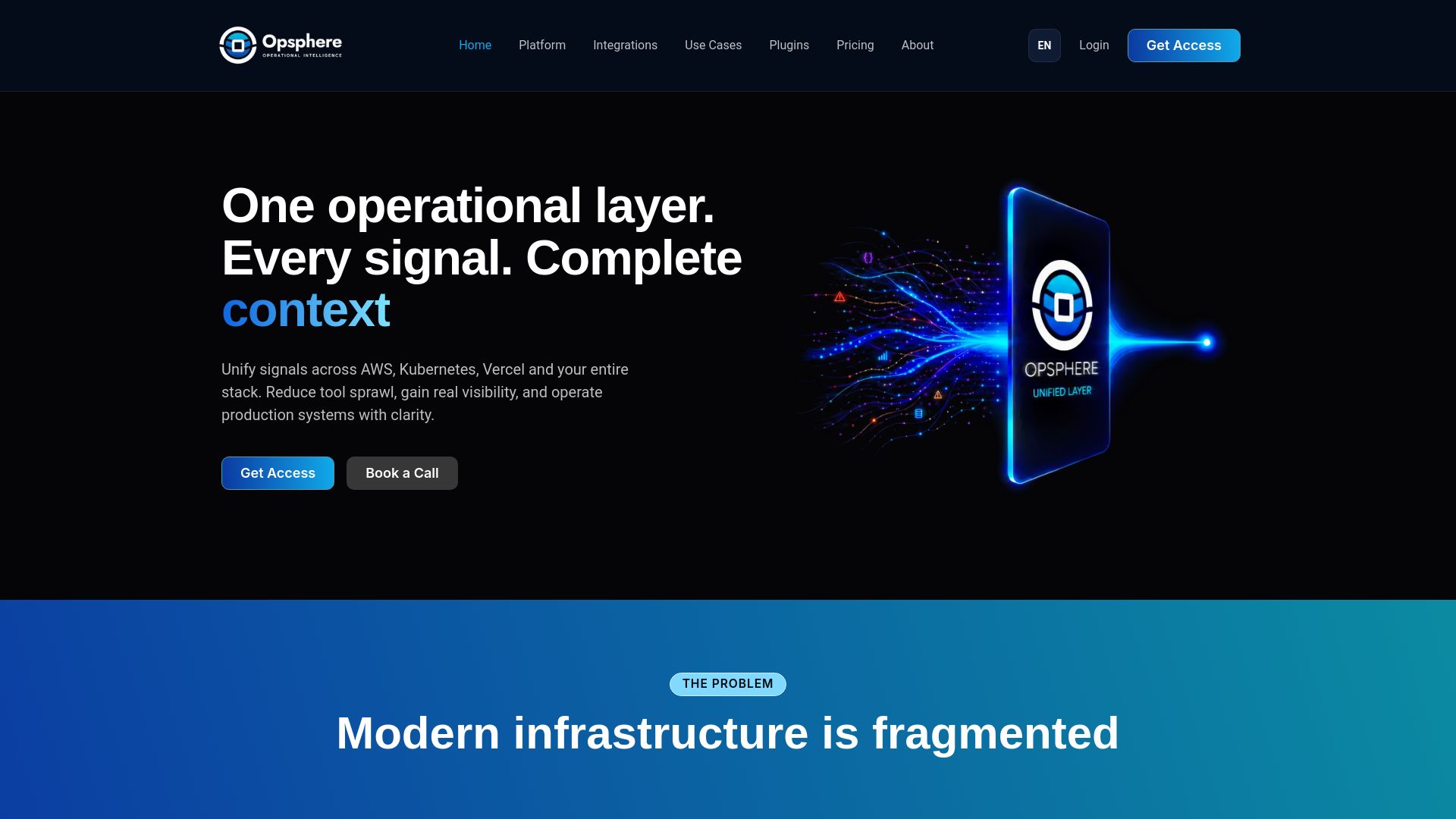
For teams already running Terraform-native pipelines, Opsphere’s Terraform-native workflows fit directly into the declarative, PR-based remediation pattern this guide recommends, and its Cursor IDE integration puts that same evidence context where engineers already work. If you’re piloting your first automation and want the observability and governance layer already wired up, start with the Opsphere web client and see what an evidence-backed operational layer looks like against your own infrastructure.
Sources
- Architecture strategies for self-healing and self-preservation - Microsoft Learn
- Infrastructure Resilience Planning Framework (IRPF) - CISA
- AXIOM: Autonomous Infrastructure Repair Agent