
Measure First, Automate Alert Fatigue for Healthcare, SOCs, DevOps
Measure First, Automate Alert Fatigue for Healthcare, SOCs, DevOps

Alert fatigue is operational and cognitive desensitization caused by excessive low-value alerts, and it raises the risk of missing the signal that actually matters. It shows up in ICU wards, security operations centers, and DevOps on-call rotations alike, degrading response times and burning out the people who carry the pagers. This piece walks through the evidence behind it, the mechanisms that create it, how to measure it, and a prioritized playbook for fixing it.
TL;DR:
- Most alert volume comes from redundant, low-action alerts, with some environments experiencing over 2 million alerts per month, overwhelming responders.
- Average override rates are high across sectors, with false positives and duplicate alerts making up the majority, leading to dismissive and reflexive responses.
- Key metrics to measure alert fatigue include alert volume, false-positive rate, override rate, MTTA, and MTTR, which help target the most troublesome sources.
- Effective fixes prioritize tiering alerts, reducing redundancy through correlation, enriching alerts with context, and piloting AI-assisted triage in shadow mode.
- Organizational policies, such as response time tiers, balanced on-call scheduling, and alert ownership, are essential to sustainably reduce noise and prevent burnout.
Table of Contents
- What Counts as an Alert, and Where Fatigue Actually Starts
- The Data Behind Alert Fatigue: How Big Is the Problem?
- Why Alerts Turn Into Noise: The Root Causes
- The Real Cost: Patient Safety, Breaches, and Burnout
- Measuring Alert Fatigue: The Metrics That Actually Diagnose It
- Fixing the Pipeline: Tiering, Correlation, and Safer AI Triage
- Building the Human Systems Around Your Alerts
- A Prioritized Playbook: What to Fix First
- How a Unified Operational Layer Cuts Through Alert Noise
- Training Teams to Handle Alerts Instead of Dreading Them
- The Mental Toll: Stress, Decision Fatigue, and Shrinking Attention
- What Successful Noise Reduction Looks Like in Practice
- Where Alert Management Is Headed Next
- My 90-Day Approach to Fixing a Noisy Alert Pipeline
- Where Opsphere Fits Into Your Alert Fatigue Fix
- Sources
What Counts as an Alert, and Where Fatigue Actually Starts
Before you can fix alert fatigue, you need to separate it from two terms it constantly gets tangled up with. Alert fatigue is the broad phenomenon: desensitization to any recurring signal, whether it comes from a hospital monitor, a SIEM, or a Kubernetes cluster. Notification overload is narrower. It refers specifically to the volume problem, too many pings across too many channels, regardless of whether each one is accurate. Alarm fatigue is the clinical-specific term used in healthcare literature, almost always describing physiologic monitors and bedside devices rather than software dashboards.
The distinction matters because it shapes what you measure and what you fix. A hospital reducing alarm fatigue is tuning device thresholds and patient-specific parameters. A SOC reducing alert fatigue is tuning detection rules and correlation logic. Same underlying cognitive failure, different levers.
A useful working taxonomy splits alerts along two axes: severity and interruption mode.
- Informational: no action required, logged for context (a deploy completed, a routine backup finished).
- Warning: worth a look, not urgent (disk usage trending upward, a login from a new but plausible location).
- Critical: requires immediate human response (a cardiac arrhythmia alarm, active data exfiltration, a production outage).
- Interruptive: designed to break focus, page, ring, or pop up regardless of what the recipient is doing.
- Non-interruptive: sits in a dashboard or digest, visible but not demanding.
The mistake most systems make is treating every alert as interruptive by default. When an informational event pages someone at 2 a.m. with the same urgency as a critical one, the recipient’s brain starts flattening the distinction. Within weeks, everything gets the same half-attention, including the alerts that were supposed to be unmissable.
Getting this taxonomy right before you touch thresholds or tooling is the cheapest fix on this list, because it costs nothing but a policy decision and a config change.
The Data Behind Alert Fatigue: How Big Is the Problem?
The scale of alert fatigue in critical care is not subtle. In one academic hospital, physiologic monitors generated more than 2 million alerts in a single month, which works out to roughly 187 warnings per patient per day. No clinician can meaningfully triage that volume, so the practical response becomes triage by exhaustion: alerts get muted, snoozed, or ignored outright.
By the numbers: ICU monitors in one hospital study produced over 2 million alerts in a month, about 187 per patient per day, and industry estimates put false-positive and redundant security alerts comprise a majority of alerts in some environments.
That override behavior is not confined to bedside monitors. Reviews of clinical decision support systems consistently find high override rates tied to alerts that are clinically inconsequential often enough that clinicians learn to click through them by reflex. Once that reflex forms, it applies indiscriminately, to the alert that is noise and the one that is not.
Security operations show a parallel pattern. Industry reporting on SOC alert volume has described environments where false and redundant alerts make up a majority of total alert traffic, with some estimates citing around half or more false positives and substantial redundancy in certain environments. Analysts facing that ratio develop the same muscle memory as an overwhelmed clinician: dismiss first, investigate rarely.
The consequences are not hypothetical. A widely cited 2011 investigation linked missed physiologic alarms to patient deaths, and later case reports have echoed the same pattern: rare events, but severe ones, that occur specifically when alarm systems generate so much noise that a real crisis blends into the background.
A few figures worth holding onto:
- ICU alert volume can be extremely high in high-acuity settings.
- Security teams in some environments discard a large proportion of alerts as false or duplicate.
- Override and dismissal behavior in clinical decision support systems is common, reflecting widespread alert fatigue, not an anomaly.
The evidence has real limits. Most published figures come from individual hospital systems or industry surveys rather than large randomized studies, so treat specific percentages as directional rather than universal. The direction, though, is consistent across every sector that has studied it: alert volume rises faster than human attention capacity, and something has to give.
Why Alerts Turn Into Noise: The Root Causes
Alert fatigue rarely traces back to a single bad decision. It builds up from a stack of smaller ones, technical, cognitive, and organizational, that compound over time.
On the technical side, unfiltered telemetry is the most common starting point. Teams instrument everything because monitoring tools make it easy, then never revisit which signals actually warrant a human response. Tool redundancy makes it worse: a single failed health check can trigger alerts from a monitoring platform, a cloud provider’s native alerting, an APM tool, and a log aggregator simultaneously, all describing the same event from four different angles.
Poor thresholds compound the volume problem. A CPU alert set to fire at 70% utilization on a system that normally runs at 75% will fire constantly and mean nothing. Alert chaining, where one failure cascades into dozens of downstream alerts, turns a single root cause into a wall of noise that obscures the actual problem. And alerts that arrive without context, no indication of asset criticality, no link to a recent deploy, no topology data, force the recipient to do investigative work before they can even decide whether the alert deserves attention.
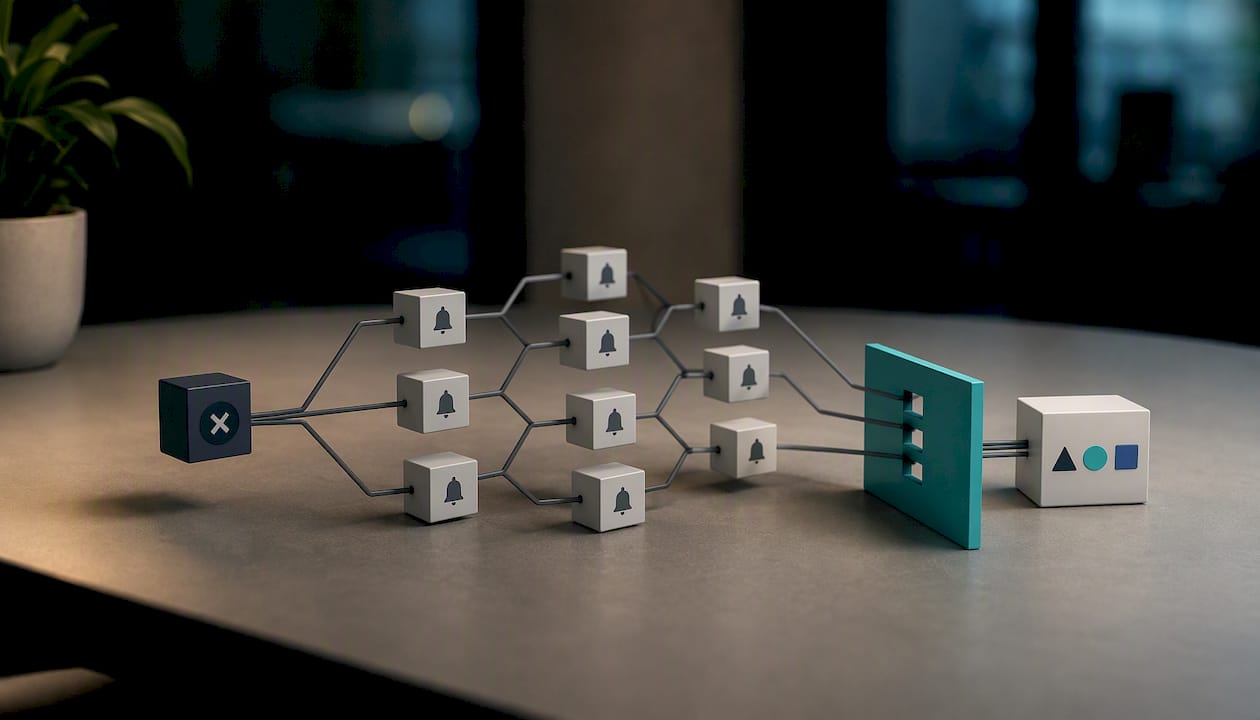
Cognitive mechanisms turn that technical noise into fatigue. Habituation is the core one: repeated exposure to a stimulus without consequence causes the brain to stop registering it as meaningful. Ambiguity about urgency compounds it. When every alert looks the same visually and audibly, the recipient has to make a judgment call every single time, and that judgment call itself is exhausting. Run that decision process hundreds of times a shift and you get decision fatigue, a measurable decline in judgment quality that shows up as slower response times and more missed escalations as a shift wears on.
Process failures usually sit underneath both. Systems ship with default alert settings that nobody revisits. No one owns the alert catalog, so nobody is accountable for retiring rules that have gone stale. Without governance, alert volume only grows.
Pro Tip: Before adding a single new alert rule, ask who owns its lifecycle and when it will next be reviewed. An alert with no named owner is an alert that will never be turned off.
The Real Cost: Patient Safety, Breaches, and Burnout
The mechanisms behind alert fatigue play out differently depending on what’s at stake, but the underlying failure mode, a critical signal lost in a pile of noise, is identical across sectors.
In healthcare, the consequence is measured in patient outcomes. Missed critical alarms have been tied to delayed responses to cardiac events, respiratory decompensation, and medication errors when infusion pump or dosage alerts get overridden by habit rather than judgment. The literature on this is blunt: alarm fatigue is not a theoretical risk, it is a documented contributor to morbidity and, in rare but real cases, mortality.
In cybersecurity, the cost shows up as dwell time. When an analyst is buried under a queue of mostly false positives, a genuine indicator of compromise sits unexamined longer than it should. That delay, the gap between initial compromise and detection, is one of the most consequential metrics in incident response, and alert fatigue directly widens it. Slower containment means more lateral movement, more data exposure, and a costlier breach by the time anyone notices.
In platform engineering and DevOps, the cost is organizational rather than acute. Chronic alert noise builds an incident backlog that never fully clears, because on-call engineers spend their attention filtering rather than resolving. MTTR (mean time to resolution) creeps upward as engineers lose trust in the alerting pipeline and start manually verifying signals before acting on them. Over months, that erosion of trust becomes attrition: experienced engineers leave on-call rotations, sometimes leave the company, because chronic interruption without corresponding signal quality is one of the most cited burnout drivers in operations work.
- Healthcare: missed alarms linked to delayed intervention in documented adverse event reports.
- Security: increased dwell time and slower containment when analysts triage a majority-noise queue.
- Operations: rising MTTR and elevated on-call attrition as trust in alerting erodes.
What ties these together is not the severity of the outcome, a missed cardiac alarm and a missed Kubernetes pod crash sit at very different stakes, but the identical cognitive failure that produces both: a human being stopped trusting the alert stream to tell them what mattered.
Measuring Alert Fatigue: The Metrics That Actually Diagnose It
You cannot fix what you have not measured, and alert fatigue is one of the easier operational problems to quantify once you know which numbers to track.
Six metrics form the core of any noise audit. Alert volume is the raw count over a defined period, broken down by source and severity. False-positive rate tracks the share of alerts that, on investigation, required no action. Duplicate rate measures how many alerts describe the same underlying event through different channels or tools. Override rate captures how often an alert gets dismissed or acknowledged without follow-up action, a strong proxy for perceived low value. MTTA (mean time to acknowledge) tracks how long an alert sits before anyone responds, and MTTR (mean time to resolution) tracks how long the underlying issue takes to close once acknowledged.
Running a noise audit is straightforward in principle. Pull a sample of alerts from the last 30 to 90 days, stratify by source and severity, and manually classify each one: did this require action, was it accurate, and did the response time match the severity it claimed to have? In healthcare settings, this typically means a clinical reviewer sampling monitor alarms against actual patient acuity. In a SOC or DevOps context, it means an engineer or analyst reviewing a sample against ground-truth incident records.
| Metric | What it reveals | Signal of a healthy system |
|---|---|---|
| Alert volume | Total signal load on responders | Trending flat or down over time |
| False-positive rate | Accuracy of detection logic | Low and consistently tracked, not just estimated |
| Duplicate rate | Tool redundancy and correlation gaps | Near zero after aggregation is applied |
| Override rate | Perceived value of alerts by responders | Reviewed regularly, not treated as noise |
| MTTA | Responsiveness under current alert load | Stable even as volume changes |
| MTTR | End-to-end resolution efficiency | Improving or holding steady quarter over quarter |
A dashboard built around these six numbers, reviewed monthly by whoever owns the alert catalog, turns alert fatigue from an anecdotal complaint (“everyone’s tired of pages”) into a tracked engineering problem with a visible trend line.
Fixing the Pipeline: Tiering, Correlation, and Safer AI Triage
Technical mitigation works best as a layered set of changes, not a single silver bullet. Each layer reduces noise without silencing the signal that actually needs a human.
- Tier alerts and match the cue to the tier. Reserve interruptive pages, sound, vibration, forced acknowledgment, for genuinely critical events. Route warnings to a dashboard or digest and informational events to a log. Aviation’s human factors research offers a useful template here: the most consequential alerts get the loudest cue, and everything else gets a graded, less intrusive signal.
- Aggregate and incidentize related alerts. Deduplication and correlation logic should group alerts describing the same root cause into a single incident record rather than paging on-call five times for one outage. This is often the single highest-leverage technical change a team can make, because it directly attacks the redundancy problem documented in SOC environments.
- Enrich alerts with operational context. An alert that says “CPU at 92%” is far less useful than one that says “CPU at 92% on a payment-critical service, five minutes after a deploy.” Adding topology, asset criticality, and recent change history turns a low-value signal into an immediately actionable one, or lets the system safely deprioritize it. This is one of the more consistent recommendations in security literature: context and correlation matter as much as detection itself.
- Use risk-based scoring with dynamic thresholds, and build in a rollback path. Static thresholds age poorly as systems change. Dynamic, risk-weighted thresholds adjust to baseline behavior, but every automated threshold change needs a safety net, a way to revert quickly if the new threshold starts suppressing real incidents.
- Pilot AI-assisted triage with a human in the loop. AI can cluster related alerts, rank them by likely severity, and surface probable root cause faster than manual correlation. The caution from security researchers is consistent: the danger is not that AI triage fails outright, it’s that blunt automated filtering can quietly suppress a true positive along with the noise. Any AI triage layer needs explainability (why was this alert deprioritized?) and a clear escalation path when the model’s confidence is low.
Pro Tip: Run AI-assisted triage in shadow mode for at least one full incident cycle before it gets any authority to suppress or auto-close alerts. Compare its recommendations against what your team actually did, and only promote it to an active role once the gap closes.
The overriding principle across all five layers is the same one security researchers keep repeating: reducing alert count is not the goal. Reducing noise while preserving true positives is the goal, and those are very different design problems. A team that just deletes 80% of its alert rules to feel better about volume will eventually get burned by whichever rule they deleted that turned out to matter.
Building the Human Systems Around Your Alerts
Technical fixes only hold if the organizational layer around them is solid. Alert fatigue is as much a policy failure as an engineering one.
Publishing explicit response-time tiers is the single highest-leverage organizational move available, and it costs nothing but a written document. When a team knows that a critical alert demands acknowledgment within 5 minutes, a warning within an hour, and an informational item by end of day, the guesswork disappears. That guesswork, an ambiguity gap between what an alert seems to demand and what it actually requires, is one of the most underappreciated drivers of chronic notification stress. Closing it with documented expectations by channel and tier measurably reduces perceived urgency and the anxiety that comes with constant ambiguity.
On-call scheduling deserves the same deliberate design. Balanced rotations that spread the burden evenly, rather than concentrating pages on one or two engineers, prevent the kind of chronic overload that produces burnout and attrition. Recovery time after a disruptive interruption is not instantaneous; research on workplace interruptions suggests it takes real time to regain full focus after a break in concentration, which is a strong argument against schedules that stack multiple people on the same low-value alert queue simultaneously.
Governance closes the loop. Someone needs explicit ownership of the alert catalog: who approves new rules, who reviews existing ones on a schedule, and who has authority to retire a rule that has outlived its usefulness.
- Publish response-time tiers by channel and severity, and revisit them quarterly.
- Design on-call rotations that distribute low-value and high-value alerts evenly.
- Assign a named owner for the alert catalog’s lifecycle review.
- Tie every runbook to a specific alert tier so responders know the expected action on sight.
None of this requires new tooling. It requires a decision about who is accountable for the noise, and a written record of what “urgent” actually means.
A Prioritized Playbook: What to Fix First
Not every fix belongs in the same sprint. Sequencing matters more than most teams assume.
- Quick wins (this week). Audit your noisiest alert sources, switch low-severity alerts to non-interruptive delivery, and cut redundant reminder pings. Owner: on-call lead. Success metric: alert volume drops without a corresponding rise in missed incidents.
- Medium-term (this quarter). Add context enrichment (topology, criticality, recent deploys), implement severity tiering, and link every alert to a runbook. Owner: platform or SRE team lead. Success metric: override rate falls and MTTA improves.
- Long-term (this year). Pilot AI-assisted triage in shadow mode, consolidate redundant monitoring tools, and formalize governance over the alert catalog. Owner: engineering leadership or a dedicated observability team. Success metric: false-positive rate and MTTR trend down over consecutive quarters.
| Phase | Primary action | Owner | Success metric |
|---|---|---|---|
| Quick win | Noise audit and non-interruptive defaults | On-call lead | Lower alert volume, stable incident detection |
| Medium-term | Context enrichment and tiering | SRE/platform lead | Lower override rate, faster MTTA |
| Long-term | AI triage pilot and tool consolidation | Engineering leadership | Lower false-positive rate, improved MTTR |
The order matters because quick wins build the credibility needed to fund the longer projects. A team that shows a measurable drop in noise within two weeks earns the budget and buy-in for a quarter-long enrichment project.
How a Unified Operational Layer Cuts Through Alert Noise
Most alert fatigue in platform engineering traces back to fragmentation: a dozen tools, each with its own alerting logic, none aware of what the others already know. Opsphere approaches this as a context problem rather than a filtering problem. It unifies operational data across AWS, Kubernetes, observability stacks, CI/CD pipelines, and security tooling into a single interface, so an alert arrives already carrying the topology, recent deploy history, and asset criticality that would otherwise take an engineer several tool switches to assemble by hand.
That context is what makes AI-assisted triage safe rather than risky. Opsphere’s AI Agents and its use of Model Context Protocol (MCP), combined with more than 300 read-only operational tools, are built with governance and security controls as a first-order concern, not an afterthought, since any system with triage authority needs an auditable trail of what it decided and why.
When evaluating any platform for this job, check for:
- Breadth of native integrations across your actual stack, not just the popular ones.
- Explainability behind any automated severity scoring or suppression.
- Read-only or governed write access, with clear audit logging for anything AI touches.
Training Teams to Handle Alerts Instead of Dreading Them
Even a well-tuned alert pipeline fails if the people receiving alerts were never trained on what to do with them. Training has to move beyond “here’s the dashboard” and into scenario-based practice: walking new hires through real historical alerts, having them decide the correct tier and response, then comparing their call against what actually happened.

Runbooks are the backbone of that training. A runbook tied explicitly to an alert’s tier, not a generic troubleshooting document, gives responders a concrete first move instead of a blank investigation. In healthcare, this looks like protocol-driven responses to specific alarm types, tailored to patient acuity, so a nurse does not have to reconstruct urgency from scratch every time a monitor sounds. In a SOC or DevOps context, it looks like a linked playbook that opens automatically when an alert fires, cutting the gap between “alert received” and “action taken.”
Regular tabletop exercises, walking through a simulated incident end to end, build the pattern recognition that reduces decision fatigue in a live event. The goal is not to memorize every possible alert, it’s to build enough repetition with the tiering system that responders trust their own judgment about what’s urgent and what can wait.
New team members should also be explicitly taught the override policy: when it’s appropriate to dismiss an alert, when it must be escalated, and who reviews override patterns for drift. Without that explicit training, override behavior forms by imitation, and bad habits spread through a team faster than good ones do.
The Mental Toll: Stress, Decision Fatigue, and Shrinking Attention
Alert fatigue is not just an efficiency problem. It has a measurable psychological signature, and ignoring that signature is part of why so many mitigation efforts stall.
Chronic interruption raises baseline stress, independent of whether any individual alert turns out to matter. The body’s stress response does not wait for a triage decision. Every page, every ping, every red banner triggers a small physiological alert of its own, and when that happens dozens of times a shift, cumulative stress builds regardless of outcome.
Decision fatigue compounds it. Every alert forces a judgment: act now, defer, or dismiss. That judgment draws on the same finite cognitive resource as any other decision, and resources deplete over a shift. Studies of decision-making under repeated choice load consistently show quality declining as the session goes on. Applied to alerting, that means the fiftieth alert of a shift gets a measurably worse judgment call than the fifth, even from the same experienced person.
Reduced attention is the visible symptom. Habituation doesn’t just make people ignore alerts; it narrows the window of attention they give to any given signal, so details that would have registered early in a shift, an unusual pattern, a slightly off metric, get missed later on. That narrowing is exactly why critical alerts get lost inside noisy streams: not because responders stop caring, but because sustained high-frequency interruption physically degrades the attention available to notice what’s different.
Recognizing this as a cognitive load problem, not a discipline problem, changes how leaders respond to it. Telling a fatigued team to “pay closer attention” ignores the mechanism. Reducing the load is the only lever that actually works.
What Successful Noise Reduction Looks Like in Practice
The clearest pattern across successful alert fatigue reduction efforts is that they start with measurement, not with deleting alerts. Teams that begin by auditing their alert catalog, classifying what’s actionable against what isn’t, consistently find that a large share of daily volume comes from a small number of noisy sources. Fixing those sources first produces an outsized drop in total volume without touching anything that actually mattered.
The second consistent pattern is sequencing: tiering and context enrichment before any automation gets introduced. Teams that jump straight to AI-assisted filtering without first fixing their taxonomy tend to automate the wrong thing, suppressing alerts that were poorly categorized to begin with rather than genuinely low-value.
The third pattern, and the one healthcare literature is most explicit about, is that mitigation has to be tailored to context rather than applied uniformly. A human factors approach means tuning alarm parameters to individual patient characteristics rather than applying one threshold hospital-wide, because a threshold that’s appropriately sensitive for one patient population generates constant false alarms for another. The DevOps equivalent is service-specific thresholds instead of fleet-wide defaults: a payment service and a batch job should never share the same CPU alert threshold.
What ties these outcomes together is patience. Every documented success story spans months, not days, because tiering, enrichment, and governance changes each need a full measurement cycle to prove they didn’t just move the noise somewhere else. Teams that treat noise reduction as a one-time cleanup rather than an ongoing discipline tend to see volume creep back within a quarter.
Where Alert Management Is Headed Next
The next wave of alert fatigue mitigation is shifting from static rules to adaptive systems that adjust their own thresholds based on observed baseline behavior rather than requiring an engineer to hand-tune every setting. Instead of a fixed CPU threshold, an adaptive system learns what “normal” looks like for a specific service at a specific time of day and only alerts on genuine deviation.

Predictive analytics is the logical extension of that shift: rather than alerting after a threshold is breached, systems increasingly try to flag the trajectory toward a breach early enough to act before an incident forms. That reframes alerting from reactive to preventive, though it raises the same explainability demands as any AI-assisted triage: a predictive alert needs to show its reasoning, not just its confidence score, or teams will distrust it exactly the way they distrust noisy legacy rules.
Correlation engines are also getting better at cross-domain reasoning, linking a security anomaly to an infrastructure change to a deployment event, rather than treating each tool’s alert stream in isolation. That’s the direction most likely to meaningfully shrink false-positive and duplicate rates, since so much noise today comes from tools that simply don’t know what their neighbors already flagged.
None of this eliminates the need for human judgment. Every credible source on this topic, from clinical alarm researchers to SOC analysts, agrees that automation’s job is to reduce the queue a human has to review, not to remove the human from the decision. The teams that get the most value from adaptive and predictive tools will be the ones that keep a clear human-in-the-loop checkpoint, especially for anything with authority to suppress an alert rather than just rank it.
My 90-Day Approach to Fixing a Noisy Alert Pipeline
If I were walking into a team drowning in alerts, I’d start with a two-week audit, not a redesign. Classify every alert source by volume and actual action taken. That data alone usually reveals which two or three sources cause most of the pain.
Quick wins come next: non-interruptive defaults for anything below critical, and killing redundant reminders. Only after that would I pilot any automation, and only in shadow mode, comparing its calls against what the team actually did before giving it authority to suppress anything.
The trade-off worth naming: every noise reduction carries some risk of cutting a signal that mattered. That’s why governance has to move at the same pace as automation, never behind it. Signs it’s working: override rates drop, MTTA holds steady even as volume falls, and your team stops joking about ignoring pages.
— José
Where Opsphere Fits Into Your Alert Fatigue Fix
Some platforms aim to unify multiple disconnected dashboards to help fight alert fatigue. Instead of hunting across your observability stack, cloud console, and CI/CD tool to figure out whether an alert is real, Opsphere unifies that context in one place, so an alert arrives with the topology, deploy history, and asset criticality already attached.
That consolidation directly targets tool sprawl, one of the biggest silent contributors to duplicate and redundant alerts across engineering teams. Platforms with numerous read-only integrations and AI Agents built on specialized protocols can help teams triage faster without handing blind authority to a black box, keeping every recommendation traceable and governance controls in the user’s hands. Security and access control are important considerations when granting any system visibility into production infrastructure. If your team is ready to see what unified operational context looks like against your own alert volume, you can explore the Opsphere web client or check out the full platform overview to evaluate a pilot.