
Cut Tool Calls From 16 to 2: AI Assisted Software Development for SREs
Cut Tool Calls From 16 to 2: AI Assisted Software Development for SREs

AI-assisted operational engineering shortens first-pass incident investigation and can auto-resolve known low-risk patterns once your alerting, runbooks, and telemetry are in shape. It works best when it augments, not replaces, human ownership of decisions. Before piloting anything, you need symptom-based alerts, structured runbooks with clear exclusion rules, and a topology baseline you trust. Start small: pick one noisy, well-understood alert class and run a read-only AI investigator against it in observer mode.
TL;DR:
- Reliable alerting must be symptom-based, tied to SLOs, and have clear exclusion rules to prevent AI from chasing noise.
- AI agents work best when the service topology, metrics, logs, and knowledge store are accurate, up-to-date, and properly labeled.
- Start small by choosing a simple alert class, authoring explicit runbook metadata, and running AI in observer mode to compare its hypotheses with human actions.
- Human oversight remains essential, especially for mitigation actions, which require clear ownership and audit trails to ensure accountability.
- Integration with existing observability tools and protocols like MCP is crucial for effective AI investigation without disrupting current workflows.
Table of Contents
- What AI-Assisted Software Development Means for Operations Teams
- Prerequisites: What Has to Be True Before You Turn AI Loose
- How to Pilot AI-Assisted Investigation Without Betting the Farm
- Governance: Keeping Humans in Control of What AI Decides
- Overview of AI-Assisted Software Development and Its Benefits
- Types of AI Tools Relevant to Operational Engineering
- Fitting AI Investigators Into Existing Workflows and Tooling
- Where AI Investigators Still Fall Short
- Bias, Fairness, and Accountability in Automated Diagnosis
- Where AI-Assisted Operations Is Headed
- Piloting Operational AI With Opsphere
- Sources
- FAQ
What AI-Assisted Software Development Means for Operations Teams
When people search “AI-assisted software development” expecting code generation, they land in the wrong place for this discussion. This article covers something different and, for production teams, more consequential: AI agents that orchestrate telemetry queries, correlate multi-signal evidence, and rank hypotheses during incident response. Think operational AI, not coding copilots.
The distinction matters because the two disciplines solve different problems. Code-generation tools help developers write and refactor application logic. Operational AI helps responders figure out why a service is degraded at 2 a.m., using the same telemetry, runbooks, and topology data your team already produces. It is AI in software engineering applied to reliability work, not to writing features.
A working definition: AI agents that pull metrics, logs, and traces, cross-reference them against known topology, and propose a ranked set of explanations with supporting evidence. The best implementations also suggest a mitigation step and flag which parts of the investigation still carry uncertainty.
High-value use cases cluster around a few repeatable jobs:
- Triage and deduplication of alerts that describe the same underlying incident
- Runbook matching, so the agent picks the right playbook instead of starting from a blank page
- Evidence-linked mitigation suggestions tied to specific trace IDs or metric thresholds
- Automated post-incident tagging that feeds your knowledge base for the next investigation
Track outcomes with concrete metrics rather than a vague sense that things feel faster. Time-to-first-hypothesis is a good leading indicator. Reduction in manual tool calls per investigation tells you whether the agent is actually doing useful correlation work. MTTR remains the lagging outcome that matters to leadership, and the percentage of investigations resolved automatically without human escalation tells you how much of your alert volume is genuinely low-risk and repeatable.
Prerequisites: What Has to Be True Before You Turn AI Loose
AI-driven coding tools get most of the industry attention, but operational AI has its own readiness bar, and most teams underestimate it. Skipping these prerequisites is the single most common reason a pilot produces noisy, low-trust results.
Alerting comes first. Google’s SRE incident management guidance is blunt about this: alerts need to be symptom-based and actionable, tied to SLOs rather than raw infrastructure thresholds. If your team pages on CPU spikes instead of user-facing latency breaches, an AI investigator will spend its time chasing noise instead of correlating real signals. The Google SRE Workbook adds a useful test: every paging alert should have a corresponding playbook entry and should trigger an immediate, well-defined human action. Deterministic sequences inside that playbook are exactly what you automate first.
Telemetry needs consistent identity. Metrics, logs, and traces only correlate cleanly when services are named the same way everywhere. OpenTelemetry’s semantic conventions define service.name, service.namespace, and service.instance for exactly this reason. Skip this and your topology graph fragments, producing confident-sounding hypotheses built on a wrong map of the system.
Topology has to reflect reality, not a diagram someone drew eighteen months ago. Knowledge stores matter too: labeled postmortems and indexed past investigations give the AI something to retrieve against instead of reasoning from scratch every time, an approach research on mining root cause knowledge from cloud incidents backs directly. Runbooks need structured metadata: which tools to call, which to skip, scope boundaries, and stopping conditions.
| Prerequisite | Minimum bar | Why it matters |
|---|---|---|
| Alerting | Symptom-based, SLO-aligned, 1:1 alert-to-incident | Prevents the agent from correlating against noise |
| Telemetry | Consistent service identity across metrics/logs/traces | Keeps topology graphs from fragmenting |
| Topology | Accurate, current dependency map | Enables causal path traversal, not guesswork |
| Knowledge store | Labeled postmortems, indexed investigations | Gives the agent prior cases to retrieve against |
| Runbooks | Tool scope, exclusion rules, stopping conditions | Narrows search space, cuts wasted tool calls |
How to Pilot AI-Assisted Investigation Without Betting the Farm
Run this as a controlled experiment, not a platform migration.
- Choose a narrow pilot. Pick one alert class that pages often, has a well-understood cause pattern, and already has a documented playbook. Avoid your most complex, ambiguous incident type for round one.
- Author runbook metadata explicitly. Write down which tools the agent should call, which it should never touch, the scope of the investigation, verification steps, and who owns sign-off on any suggested action.
- Lock down access before you deploy anything. Use read-only connectors, route through private or VPC-scoped endpoints, and rate-limit tool calls so a misbehaving agent can’t hammer your observability backend.
- Run in observer mode first. Let the AI investigator generate hypotheses and proposed tool calls in parallel with your human on-call response, without acting on anything. Compare its output against what the human actually did, and log every accept or reject decision.
- Evaluate against real metrics. Measure reduction in manual triage time, the drop in tool calls per investigation, and the percentage of hypotheses your engineers actually accepted. Feed the rejects back into runbook revisions.
Pro Tip: Don’t judge the pilot by whether the AI found the “right” answer. Judge it by whether the evidence it surfaced would have gotten a human to the right answer faster.
The evidence for this approach is concrete. A CNCF-documented deployment of HolmesGPT found that adding runbook exclusion rules cut wasted tool calls from 16 down to 2 per investigation, and dropped manual triage time from roughly a quarter of an hour down to a couple of minutes reading a threaded summary. That same deployment resolved a significant portion of investigations automatically. None of that came from a better model. It came from better runbooks constraining what the model was allowed to try.

Governance: Keeping Humans in Control of What AI Decides
Every nontrivial mitigation needs a human owner who signs off before anything changes in production. That is not a compliance checkbox; it is the difference between an assistant and an incident.
Security controls need to be specific, not aspirational:
- Read-only connectors everywhere the agent touches infrastructure
- Private model endpoints instead of routing sensitive telemetry through public APIs
- Provenance and audit trails on every tool call and hypothesis the agent generates
- No sensitive data (credentials, customer PII, raw secrets) passed into prompts
The NIST AI cybersecurity framework profile draft recommends exactly this kind of layered governance, pairing automated incident response and playbook creation with continuous evaluation rather than a one-time approval. Model behavior drifts as your infrastructure changes, so plan for recurring evaluation against labeled incidents, not a single acceptance test at launch.
The output format matters as much as the model. Microsoft’s Azure incident research found that incidents typically have multiple contributing factors, so an AI investigator should return ranked hypotheses with evidence, a confidence breakdown, and a recommended next verification step, never a single confident root cause. Pair that with a fixed review cadence for playbooks and on-call training so postmortem labels keep feeding the knowledge graph.

Overview of AI-Assisted Software Development and Its Benefits
Applied to operations, AI-assisted software development means using models and agents to handle the repetitive, evidence-gathering work that used to consume an on-call engineer’s first fifteen minutes of every page: pulling dashboards, gripping logs, checking recent deploys, and cross-referencing known incidents.
The benefit isn’t that AI replaces engineering judgment. It’s that automated software development workflows compress the distance between “alert fires” and “human has enough context to make a decision.” An agent that already knows which service depends on which, and has read the last twenty related postmortems, starts the investigation with a head start no human gets cold.
Teams that adopt this well report faster time-to-first-hypothesis and fewer manual tool calls per incident, freeing senior engineers from repetitive triage so they spend more time on the incidents that actually need deep expertise. The benefit compounds over time, too: every resolved incident that gets tagged and fed back into the knowledge store makes the next investigation slightly faster. That flywheel is the actual payoff of intelligent software collaboration between humans and models, not a one-time productivity bump.
Types of AI Tools Relevant to Operational Engineering
The broader AI-driven coding tools category includes code completion, automated test generation, and debugging assistants built for developers writing application logic. Those are not the focus here, but understanding the taxonomy helps you place operational AI correctly within your toolchain.
For SRE and platform teams, the relevant categories look different:
- Correlation engines that ingest metrics, logs, and traces and surface which signals moved together around the time of an alert
- Topology-aware diagnostic agents that walk a service dependency graph to propose causal paths, not just coincidental timing
- Runbook execution assistants that match an incoming alert to a matching playbook and pull in only the tools that playbook specifies
- Knowledge retrieval systems that search past postmortems and investigations for structurally similar incidents
Some AI development platforms bundle several of these into a single agent framework, letting one investigation flow move from correlation to topology traversal to knowledge retrieval without an engineer manually stitching tools together. The distinguishing factor between platforms isn’t model sophistication. It’s how well the surrounding scaffolding, the runbook structure, the topology accuracy, the knowledge index, constrains what the agent is allowed to search.
Fitting AI Investigators Into Existing Workflows and Tooling
Operational AI earns its keep by living inside the tools your team already has open during an incident, not by asking engineers to context-switch into a separate interface mid-page.
That means integration points matter more than raw model capability. A useful AI investigator connects to your existing observability stack (metrics, logging, and tracing backends), your incident management or paging tool, your CI/CD pipeline for recent deploy correlation, and your chat platform for posting threaded findings where the on-call engineer is already looking. Web-based access matters too, since not every responder is at a laptop with a full IDE running when a page fires; a lightweight web client for querying operational context remotely closes that gap during off-hours incidents.
The integration should be read-only by default. Query access to dashboards, log indexes, and trace stores gives the agent everything it needs to build a hypothesis without granting it write access to anything that could make an incident worse. Model Context Protocol (MCP) has emerged as a practical standard here, giving agents a structured way to call operational tools without custom glue code for every integration.
Workflow fit also means respecting existing on-call rotations and escalation paths. An AI agent that skips the assigned on-call engineer and posts findings into the wrong channel creates confusion, not speed. Integration success looks like the agent’s output landing exactly where the human would have gone looking anyway.
Where AI Investigators Still Fall Short
AI in software engineering applied to operations has real limits, and pretending otherwise is how pilots lose trust fast.
Ambiguous, novel incidents remain hard. Agents trained or configured against historical patterns struggle with genuinely new failure modes that don’t resemble anything in the knowledge store. That’s expected: Microsoft’s AutoARTS research found that incidents commonly have multiple contributing factors, and an agent working from incomplete precedent will underweight causes it hasn’t seen before.
Alert quality caps AI quality. No amount of correlation sophistication fixes an environment where alerts fire on noisy thresholds instead of user-facing symptoms. Fix the alerting first, per Google’s SRE guidance, or the AI just gets faster at investigating the wrong thing.
Topology drift produces confident wrong answers. If your dependency graph is stale, a causal-path agent will traverse it anyway and hand back a plausible-sounding but incorrect hypothesis. Nothing in the model catches that error; only accurate topology data does.
Tool sprawl creates wasted calls. Without exclusion rules narrowing scope, agents burn time and API budget querying irrelevant systems. The CNCF-documented fix, cutting wasted calls from 16 to 2 through runbook constraints, shows this is solvable, but it requires deliberate runbook engineering, not a smarter model.
Interpretability remains a genuine gap. Production systems like Groot show high precision is achievable with knowledge graphs and event-graph approaches, but eBay’s own writeup is candid that deployments still require human validation layered on top of the model’s output.
Bias, Fairness, and Accountability in Automated Diagnosis
Bias in operational AI looks different from bias in code-generation models, but it’s just as real and often less discussed.
The most common form is historical bias in the knowledge store. If your postmortem archive overrepresents certain failure types (say, database timeouts) because they were easier to document, an agent retrieving against that archive will over-index on those patterns and underweight less-documented but equally real failure modes. That’s a data curation problem, not a model flaw, and it means the team maintaining the knowledge graph carries real responsibility for what gets fed into it.
Accountability has to stay with a named human, not the agent. When an AI investigator suggests a mitigation and an engineer approves it, that engineer owns the outcome. Blurring that line, letting “the AI recommended it” become an implicit excuse, erodes the incident review process that makes postmortems useful in the first place.
Confidence miscalibration is its own ethical issue. An agent that presents a low-confidence hypothesis with the same tone as a high-confidence one nudges responders toward premature action. This is why an honest output contract, ranked hypotheses with explicit confidence and contradictory evidence, isn’t just good engineering. It’s a fairness question about how much weight a tired on-call engineer at 3 a.m. should place on an unverified claim.
Governance policies should require periodic review of what’s going into the knowledge graph, not just what’s coming out of the agent.
Where AI-Assisted Operations Is Headed
A few trends are already visible in how machine learning software solutions for operations are evolving, and they point toward tighter integration rather than flashier models.
Multi-agent investigation is replacing single-agent triage. Instead of one model handling an entire investigation, specialized agents are starting to split work: one focused on log correlation, another on topology traversal, another on drafting the postmortem summary, coordinated through a shared context layer.
Knowledge graphs are becoming the durable asset, not the model. Teams are realizing that swapping in a newer model provides marginal gains, while a richer, better-curated causal knowledge graph compounds in value with every incident it absorbs.
Standardized tool protocols are reducing integration overhead. Model Context Protocol adoption is making it faster to connect new operational tools without bespoke glue code for each one, which lowers the cost of expanding an agent’s read-only reach.
Continuous evaluation is moving from optional to expected. As NIST’s draft guidance makes clear, organizations deploying AI for incident response increasingly need drift detection and acceptance thresholds baked into the operating model, not bolted on after a bad incident.
Cross-team knowledge sharing is next. Expect more platforms to support federated learning across teams within an organization, so one team’s well-documented database failure pattern strengthens diagnosis for teams that haven’t seen it yet.
Piloting Operational AI With Opsphere
Opsphere connects to the observability, cloud, and DevOps tools you already run, without asking you to replace anything or duplicate telemetry into a second system. That matters because the prerequisites this article walks through, alert quality, topology accuracy, runbook structure, are only useful if the AI layer sitting on top of them can actually see your existing data instead of a shadow copy of it.
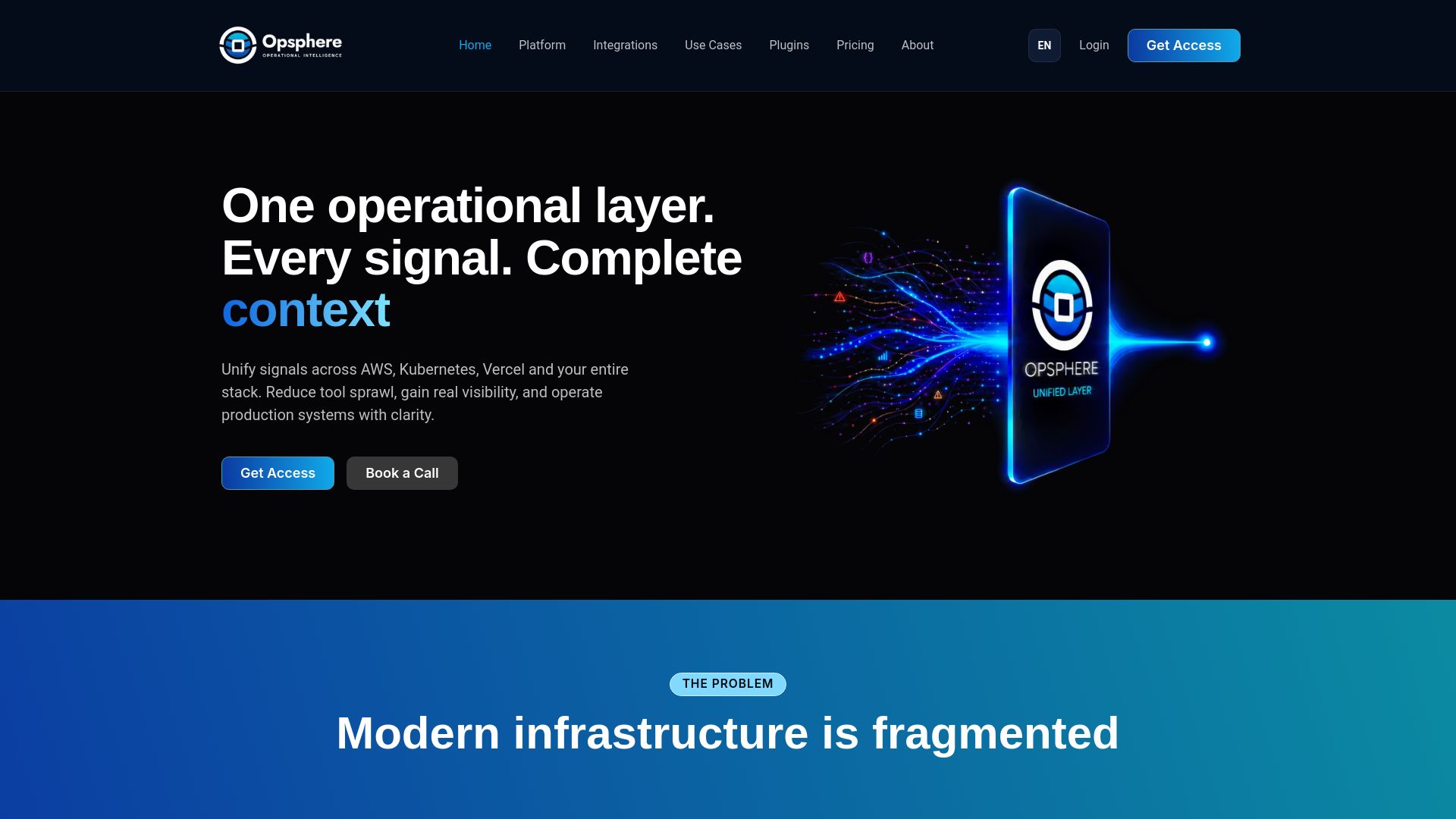
The platform combines AI Agents with Model Context Protocol and more than 300 read-only integrations across AWS, GCP, Azure, Kubernetes, and common CI/CD and security tools, giving you one place to investigate incidents instead of a dozen browser tabs. Structured investigation is built in: parallel hypothesis testing, evidence tracking, and context memory across incidents, all running through strict read-only access so a pilot never risks write permissions on production systems. A web client supports remote investigations when you’re not at your primary workstation.
A sensible pilot mirrors the rollout plan above: connect Opsphere as a read-only layer over one alert class, author the runbook metadata for that class, and run the agent in observer mode against your human baseline. From there, check the pricing plans, which range from the Community tier at €0 per month to Developer at €19 per month, Enterprise at €450 per month, and Team at €500 per month, or bring your own model through the AI engine compatibility page if your organization already standardizes on a specific provider. Teams building custom agentic workflows on top of this kind of integration layer sometimes bring in a partner like LogicBranch to design the glue code for enterprise-specific runbooks. Request a demo to see how the observer-mode workflow maps onto your own alert volume before committing to a full rollout.
Sources
- Google SRE — Incident management guide
- Auto-diagnosing Kubernetes alerts with HolmesGPT and CNCF tools
- Microsoft Azure incident analysis (AutoARTS research)
- NIST AI cybersecurity framework profile draft
FAQ
Is AI-Assisted Operational Engineering the Same as AI Code Generation?
No. AI-assisted operational engineering focuses on incident investigation, alert correlation, and runbook execution during production issues, while code-generation tools help developers write and refactor application code. They use similar underlying models but solve completely different problems for different audiences.
What’s the Biggest Blocker to a Successful AI Investigation Pilot?
Poor alert quality is the most common blocker. If alerts aren’t symptom-based and tied to SLOs, an AI investigator spends its effort correlating against noise instead of real signals, a problem Google’s SRE guidance flags as foundational.
How Much Do Runbook Exclusion Rules Actually Matter?
Significantly more than most teams expect. A documented CNCF deployment cut wasted tool calls from many to just a few per investigation and dropped manual triage time from roughly a quarter of an hour down to a couple of minutes simply by adding exclusion rules, without changing the underlying model.
Should AI Ever Automatically Apply a Mitigation Without a Human?
Only for deterministic, low-risk patterns your team has explicitly pre-approved, and even then with an audit trail. For anything nontrivial, a named human owner should approve the action before it runs, which keeps accountability clear if something goes wrong.
Does Opsphere Replace My Existing Observability Stack?
No. Opsphere connects to the observability, cloud, and DevOps tools you already run through read-only integrations rather than replacing them, so you keep your existing tools as the source of truth. Pricing starts at €0 per month on the Community tier, with paid tiers for teams that need broader integration and governance controls.
Recommended
This article is provided for general informational purposes only and does not constitute professional, legal, security, or compliance advice. Please evaluate recommendations against your organization’s specific environment and requirements.